8.3 - Orbits
Gravity provides the force that creates orbits
- Planets orbit the Sun, and moons and artificial satellites orbit planets, in almost circular orbits.
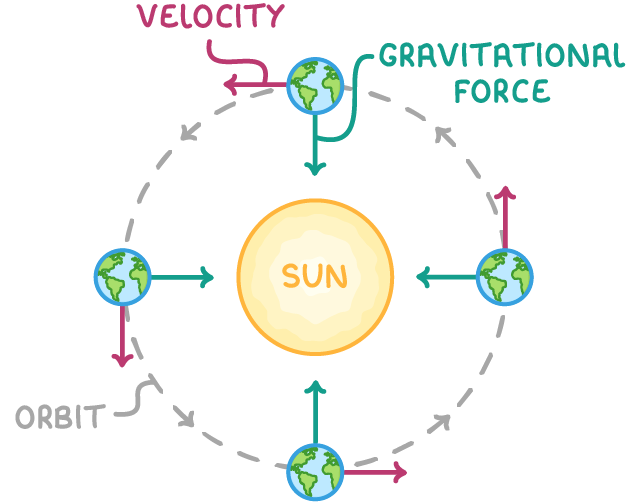
- An object moving in a circle is constantly changing direction, so even at a constant speed its velocity is constantly changing.
- A changing velocity means the object is accelerating, which requires a resultant force.
- This force acts towards the centre of the circle.
Gravity provides the inward force
- For an orbiting object, this inward force is provided by gravity:
- The Sun's gravitational pull keeps planets and comets in orbit.
- A planet's gravitational pull keeps moons and artificial satellites in orbit.
- Because the object is already moving, the gravitational pull doesn't pull it straight in - it constantly bends its path into a circle.
Gravity keeps planets and satellites in circular orbits
- Planets orbit the Sun in almost circular orbits, and moons and artificial satellites orbit planets the same way.
- The force that keeps them in orbit is the gravitational force, which acts towards the centre of the orbit.
Why velocity changes while speed stays constant
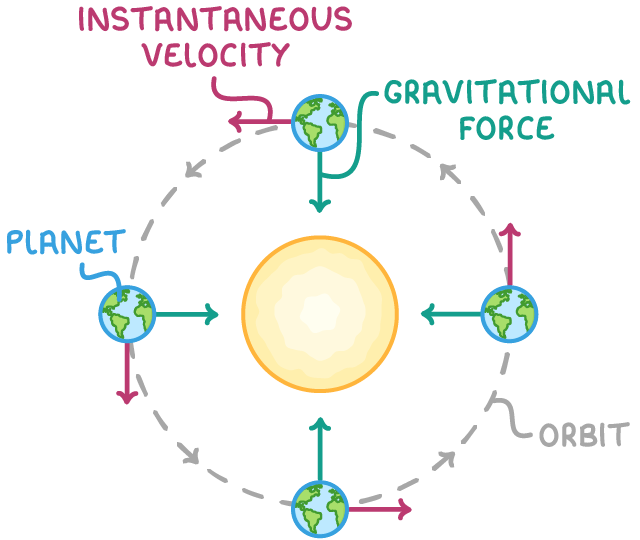
- The gravitational force acts at right angles to the object's instantaneous velocity.
- This changes the object's direction of motion without changing its speed.
- Because direction changes constantly, the velocity is constantly changing and the object is accelerating towards the centre of the orbit.
Orbital speed and radius
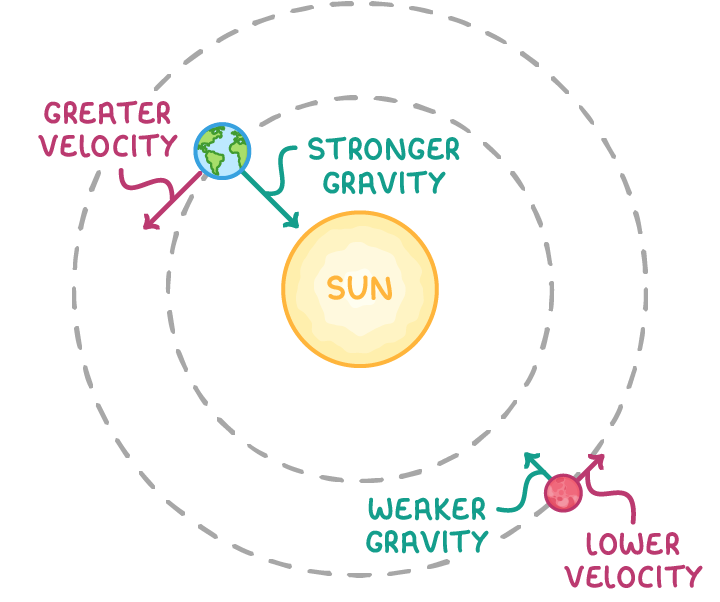
- Gravitational force is stronger closer to a star or planet.
- To maintain a stable orbit at a smaller radius, an object must travel faster so it doesn't get pulled inwards.
- If an object's orbital speed changes, its radius must change too:
- A faster object orbits at a smaller radius.
- A slower object orbits at a larger radius.
Natural and artificial satellites and their uses
- A satellite is an object that orbits a larger object in space.
- The Moon is a natural satellite of the Earth; satellites placed into orbit by humans are artificial satellites.
Uses of artificial satellites
- Communications - Transmitting television broadcasts, phone calls, and internet data
- Navigation - Providing GPS signals for vehicles and smartphones
- Weather forecasting - Monitoring clouds, temperatures, and storms
- Earth observation - Tracking climate change, agricultural land use, and pollution
- Astronomy - Housing telescopes (like the Hubble Space Telescope) above the atmosphere to avoid atmospheric distortion
- Military - Surveillance and reconnaissance
Geostationary and polar satellites
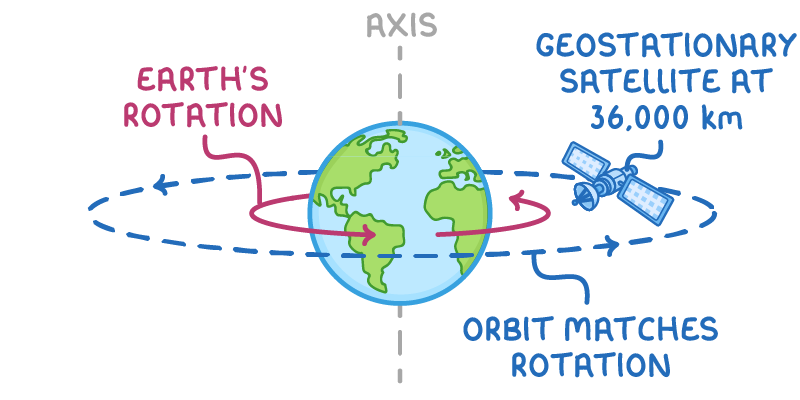
- A geostationary satellite orbits above the Earth's equator at an altitude of about 36,000 km with an orbital period of 24 hours.
- Because its period matches the Earth's rotation, it stays above the same point on the surface.
- This makes geostationary satellites ideal for communications, as ground receiver dishes can point at a fixed spot in the sky.
Low polar orbits
- A satellite in a polar orbit travels over the North and South Poles at a much lower altitude, with an orbital period of around 2 hours.
- As the Earth rotates beneath the satellite, it covers a different strip of the Earth on each orbit, eventually imaging the entire surface.
- This makes polar orbits ideal for weather monitoring, mapping, and Earth observation.
TermDefinition
SatelliteAn object that orbits a larger object in space.
Artificial satelliteA satellite that humans have built and put into orbit.
Geostationary satelliteA satellite that orbits above the equator with a period of 24 hours, so it stays above the same point on the Earth's surface.
Polar orbitA low-altitude orbit that passes over the Earth's North and South Poles.