9.3 - Strength of an Electromagnet
The experiment
Aim
To find out how the strength of an electromagnet depends on the current flowing through its coil, on the number of turns of wire in the coil, and on the material of its core.
Background
- A current in a wire makes a magnetic field around it.
- Winding the wire into a coil, a solenoid, makes the fields of all the turns add together into a strong field.
- A soft iron core inside the coil becomes an induced magnet while the current flows, which makes the field much stronger. A solenoid with an iron core is an electromagnet.
- You can't see how strong the field is, but a stronger field holds more iron nails.
- So in this practical you change the current, the number of turns, and the core, and count the nails the electromagnet holds each time.
Variables
- Independent variable - The current, the number of turns, or the core material, changed one at a time.
- Dependent variable - The number of nails the electromagnet picks up.
- Control variables - The two factors not being changed, and identical nails.
Method
- Wind the coil - Wind 50 turns of insulated copper wire neatly round a soft iron core.
- Build the circuit - Connect the coil to a low-voltage d.c. supply through an ammeter, a variable resistor, and a switch, and clamp it just above a pile of iron nails.
- Count the nails - Set the current, lower the electromagnet until it just touches the pile, lift it straight up, and count the nails hanging from it.
- Change the current - With 50 turns and the same core, take readings from 0.5 A to 2.5 A in steps of 0.5 A.
- Change the number of turns - At one fixed current, add ten turns at a time up to about 70, resetting the current with the variable resistor before every reading.
- Change the core - At a fixed current and number of turns, try an iron nail, a steel nail, an aluminium rod, a plastic rod, and no core.
- Plot the results - Plot the number of nails against the current, and against the number of turns. Show the core results on a bar chart.
Safety
- Hot wires - Switch off after every reading, and let the coil cool before you unwind it.
- Low voltage - Keep the supply at or below the voltage your teacher sets.
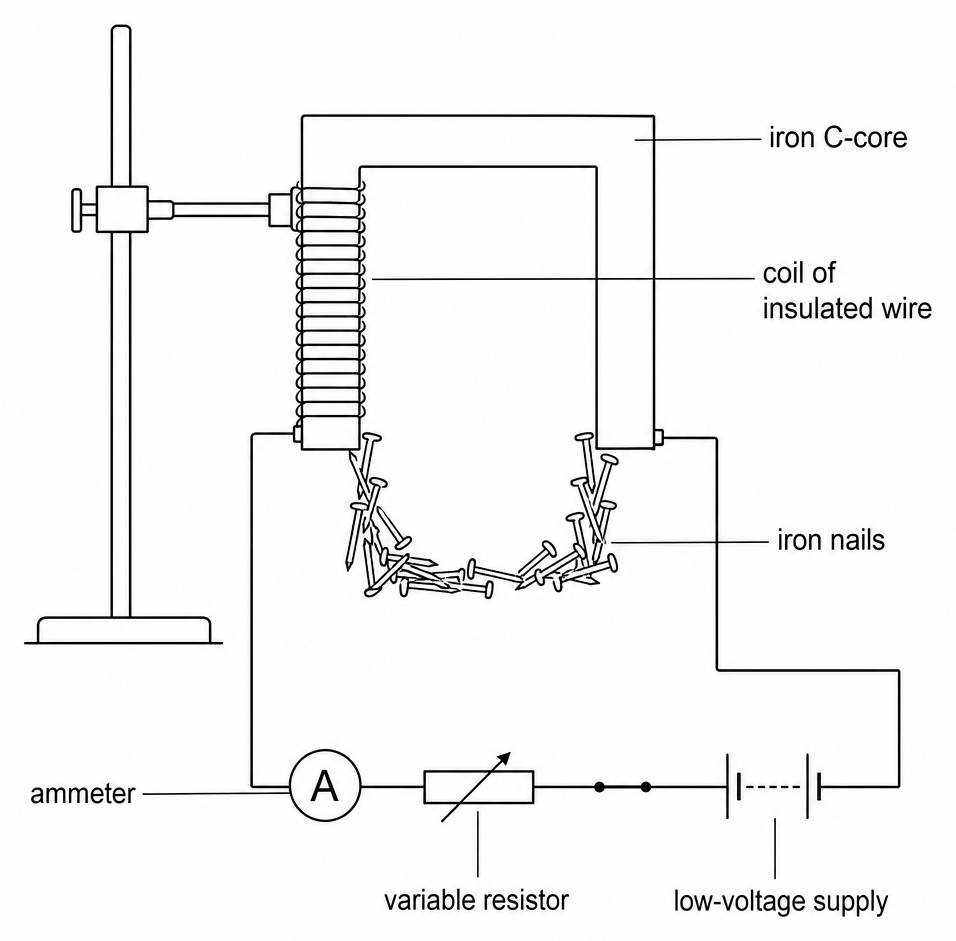
Worked example - Nails held against current
A student built an electromagnet with 50 turns of wire on a soft iron core. They counted the nails it held at six currents, keeping the turns and the core the same throughout.
| Current (A) | 0.0 | 0.5 | 1.0 | 1.5 | 2.0 | 2.5 |
|---|---|---|---|---|---|---|
| Number of nails held | 0 | 3 | 6 | 8 | 11 | 15 |
Describe what the results show, and say whether the number of nails is proportional to the current.
Step 1 - Check only one thing was changed
The turns and the core stayed the same, so any change in the number of nails is down to the current.
Step 2 - Describe the trend
The number of nails rises steadily with the current, and with no current the magnet holds none, so the line starts at the origin. Doubling the current from 0.5 A to 1.0 A doubles the count from 3 to 6.
Step 3 - Test whether it's proportional
If the count were proportional to the current, the number of nails divided by the current would be the same every time.
The values scatter between 5.3 and 6.0 but don't drift steadily up or down, so the results fit a proportional relationship.
Step 4 - Explain the scatter
Counting nails is a rough measure. You can only count whole nails, a nail only hangs on if it's lying where the field can catch it, and one extra nail out of eight is a change of more than 10%. So the points wobble either side of a straight line.
The conclusion is that the strength of the electromagnet increases as the current increases. A newtonmeter or a magnetic field sensor would give a continuous scale and a straighter line.
Common exam questions
Question 1
Why is a soft iron core used rather than a steel one?
Soft iron loses its magnetism as soon as the current is switched off. Steel keeps its magnetism, so the electromagnet would go on holding the nails.
Question 2
A student increases the coil from 20 turns to 40 turns without touching the variable resistor, and the current falls from 2.0 A to 1.4 A. Explain why, and say what they should do.
More turns means a longer wire and more resistance, so the current falls. They should use the variable resistor to set the current back to 2.0 A.
Question 3
An aluminium core holds the same number of nails as no core at all. Explain this result.
Aluminium isn't a magnetic material, so it isn't magnetised by the coil and adds no field of its own.
Question 4
Why should the supply be switched off between readings?
The current warms the coil, and warmer wire has a higher resistance, so the current would drift down from the value that was set. Hot wire can also melt the insulation.