7.10 - Why Radiation Is Harmful
How ionising radiation damages living cells
- Ionising radiation enters living cells and ionises the atoms and molecules inside them.
- Removing electrons damages or destroys these molecules, which damages the cell.
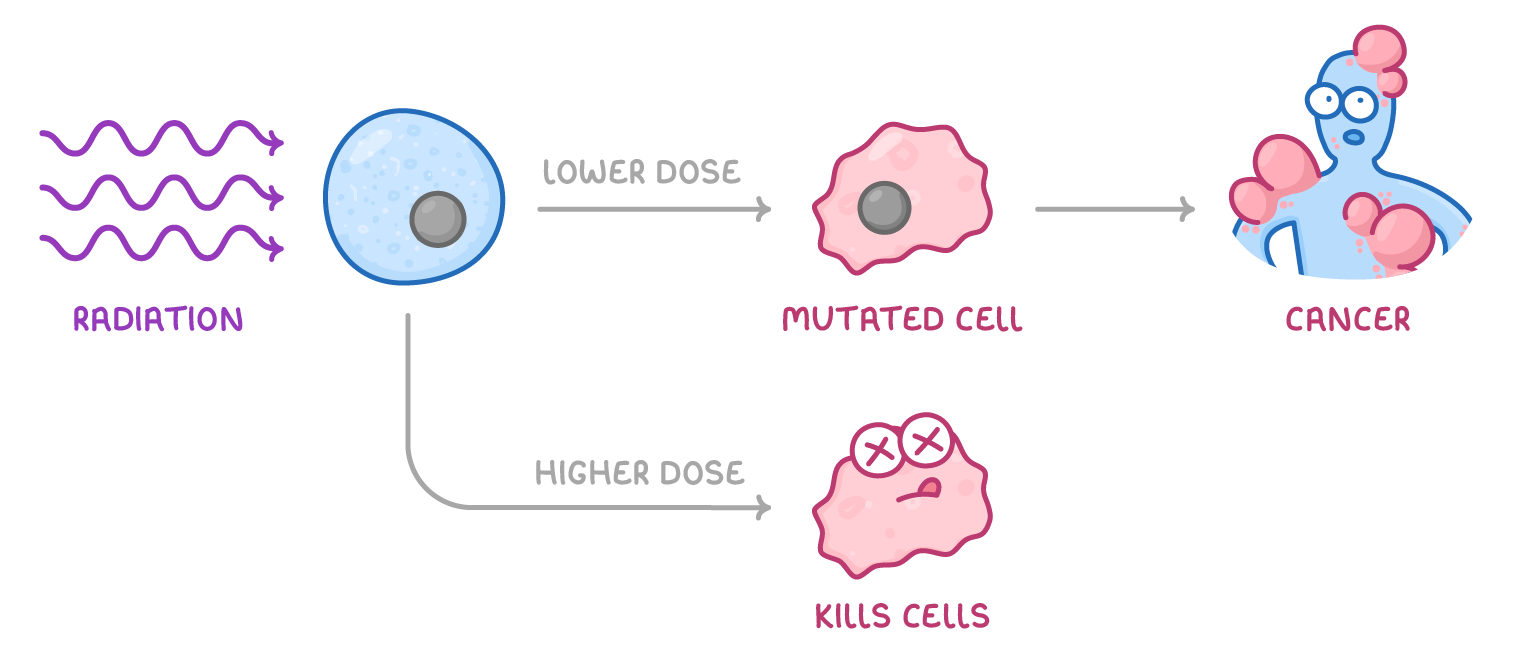
- The amount of harm depends on the radiation dose.
Lower dose - Mutation and cancer
- A lower dose tends to cause minor damage without killing the cell.
- This damage can mutate the cell's DNA.
- A mutated cell may divide uncontrollably, leading to cancer.
Higher dose - Radiation sickness
- A higher dose kills cells outright.
- Killing a large number of cells at once causes radiation sickness, with symptoms such as vomiting, tiredness and hair loss.
- Very high doses can be fatal.
Ionising power
- The more ionising the radiation, the more damage it causes to cells.
- Most to least ionising: alpha → beta → gamma.
Radiation hazards inside and outside the body
How dangerous a radioactive source is depends on the type of radiation and whether the source is outside the body (irradiation) or inside it (contamination).
Outside the body (irradiation)
- Beta and gamma are the most dangerous because they can penetrate the skin and reach internal organs.
- Alpha is the least dangerous because it can't penetrate the outer layer of skin and is stopped by a few centimetres of air.
Inside the body (contamination)
- Alpha is the most dangerous because it is the most strongly ionising and all of its energy is absorbed in a small, concentrated area of tissue.
- Beta is less dangerous because its energy is spread over a wider area, and some passes out of the body.
- Gamma is the least dangerous because it is weakly ionising and most of it passes straight out of the body without being absorbed.
TermDefinition
Radiation sicknessA condition caused by a high dose of radiation killing a large number of cells at once.