6.4 - Velocity-Time Graphs
Reading a velocity-time graph
A velocity-time graph shows how an object's velocity changes as time passes.
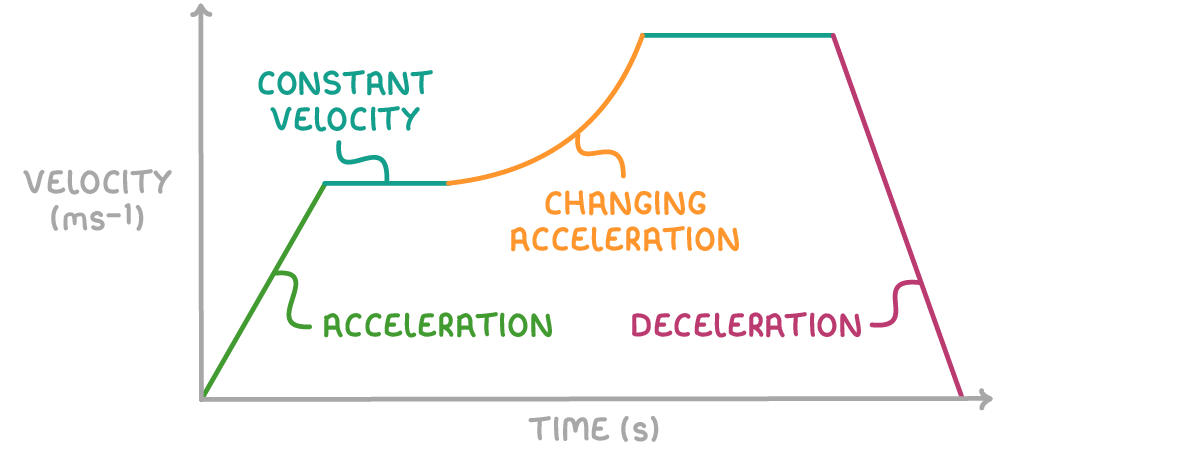
- A flat section means a steady (constant) velocity.
- An uphill section (going up to the right) means the object is accelerating.
- A downhill section (going down to the right) means the object is decelerating.
- The steeper the line, the greater the acceleration or deceleration.
- A straight line means constant acceleration.
- A curve means the acceleration is changing.
The gradient gives the acceleration
- The gradient (steepness) of a velocity-time graph equals the object's acceleration - it's the change in velocity divided by the time taken.
- For a straight section, divide the change in velocity (the rise) by the time taken (the run).
Finding the acceleration on a curve
- Where the line is curved, the gradient is different at every point.
- To find the acceleration at a particular moment, draw a tangent to the curve at that point and find the gradient of the tangent.
A line below the time axis
- If the line drops below the time axis, the object has a negative velocity.
- This means it's moving in the opposite direction.
TermDefinition
TangentA straight line that touches a curve at a single point, used to find the gradient of the curve at that point.