3.12 - Ultrasound
What ultrasound is
- Ultrasound is sound with a frequency higher than 20,000 Hz (20 kHz).
- This is above the upper limit of human hearing, so people can't hear ultrasound.
- Ultrasound can be produced electronically: an electrical oscillator generates oscillations at the required frequency, which are converted into mechanical vibrations to create the sound wave.
Partial reflection and ultrasound echoes
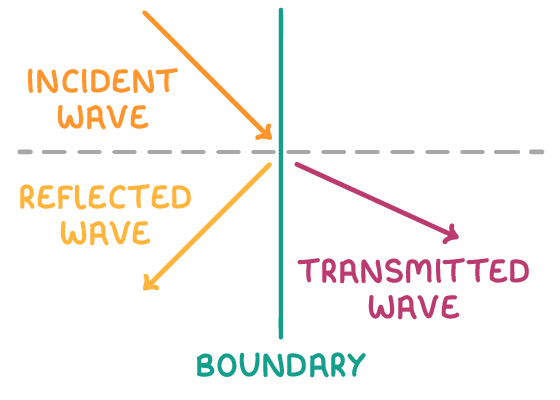
When a wave reaches a boundary between two different media, part of it is transmitted and part of it is reflected back. This is called partial reflection.
Using echoes to find a boundary
- A short pulse of ultrasound is sent into a material where the wave's speed is known.
- Measuring the time it takes for the reflection to return allows the distance to the boundary to be calculated using:
Distance = speed × time
Uses of ultrasound and radar
Medical imaging
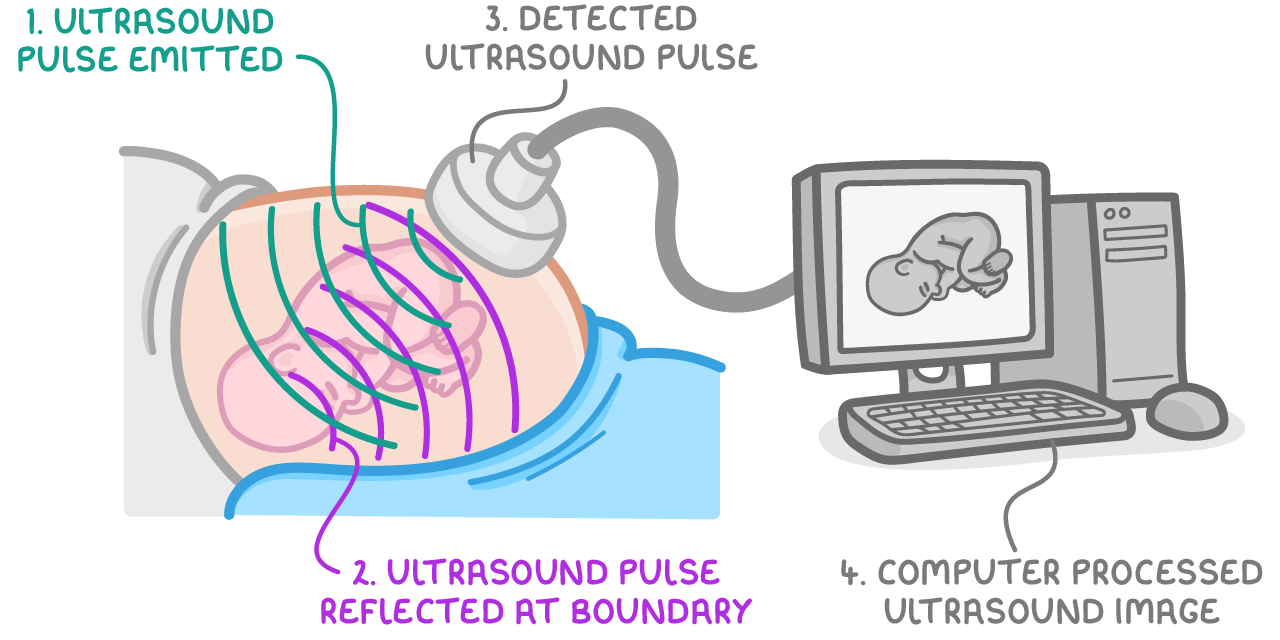
- Ultrasound passes through the body, but at every boundary between two different tissues (e.g. between fluid in the womb and the skin of a foetus), some of the wave is reflected back and detected.
- A computer processes the timing and distribution of these echoes to produce an image of internal structures or a developing foetus.
- Also used to examine soft tissues and organs (kidneys, liver, bladder).
- Safer than X-rays because it doesn't use ionising radiation.
Industrial flaw detection
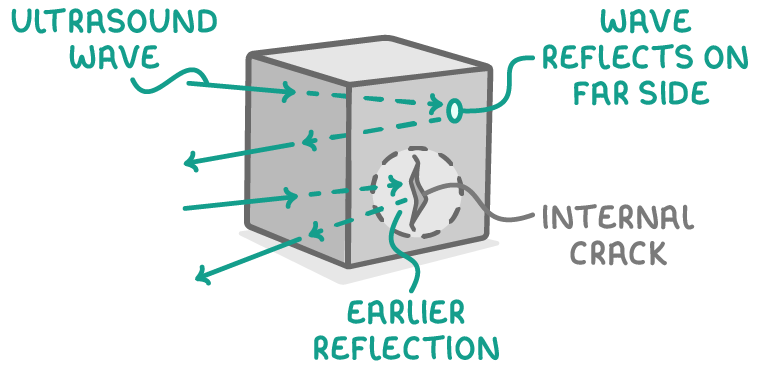
- Ultrasound entering a material is usually reflected by the far side. A flaw such as an internal crack reflects the wave sooner.
- Used to detect flaws in pipes, railway tracks, and metal castings without cutting them open.
Echo sounding and sonar
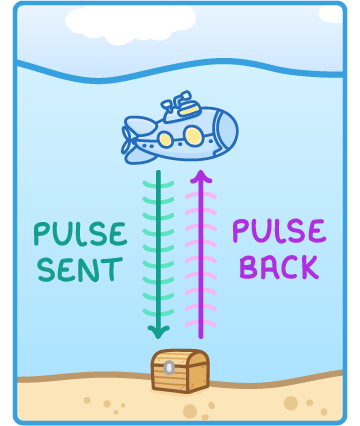
- Used by boats and submarines to find water depth or locate objects in deep water.
- A pulse of ultrasound sent into the water reflects off the seabed or an object, and the time taken for the reflection to return gives the distance.
Radar
Radar (RAdio Detection And Ranging) works the same way as sonar but uses microwaves (electromagnetic waves) instead of sound to locate distant objects like aircraft and ships.
Worked example - Depth from an ultrasound echo
A pulse of ultrasound takes 1.2 s to travel from a ship on the surface down to the seabed and back up to a detector on the ship. The speed of sound in seawater is 1,500 m/s. How deep is the seabed below the ship?
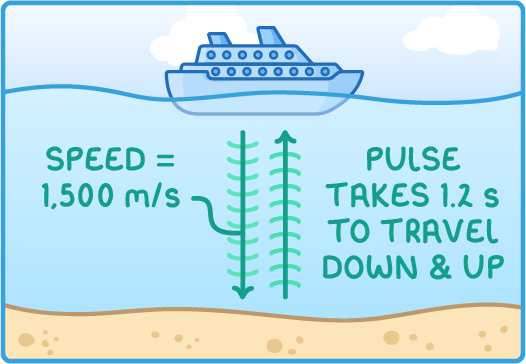
Step 1 - Find the total distance the pulse travels
The pulse travels at a known speed for the measured time, so use distance = speed × time.
Distance = 1,500 × 1.2 = 1,800 m
Step 2 - Halve the total distance
The 1.2 s is the time for the pulse to travel down to the seabed and back, so the pulse covers the depth twice. The depth is half the total distance.
Depth = 1,800 ÷ 2 = 900 m
The seabed is 900 m below the ship.