8.3 - Waves in Water & in a Solid
The experiment
Aim
To find out how the depth of water affects the speed of a wave travelling through it.
Background
- The wave speed is how far the wave travels each second. It's , where is the distance travelled in m and is the time taken in s.
- The speed of a water wave depends on the depth of the water.
- A wave's speed can't be read off directly, but you can time a single pulse over a measured distance.
- So in this practical you time a pulse along a tray of water at different depths, and work out its speed at each depth.
Variables
- Independent variable - The depth of water in the tray.
- Dependent variable - The time the pulse takes to travel three tray lengths.
- Control variables - The tray, a level bench, the distance timed over, and the way the pulse is started.
Method
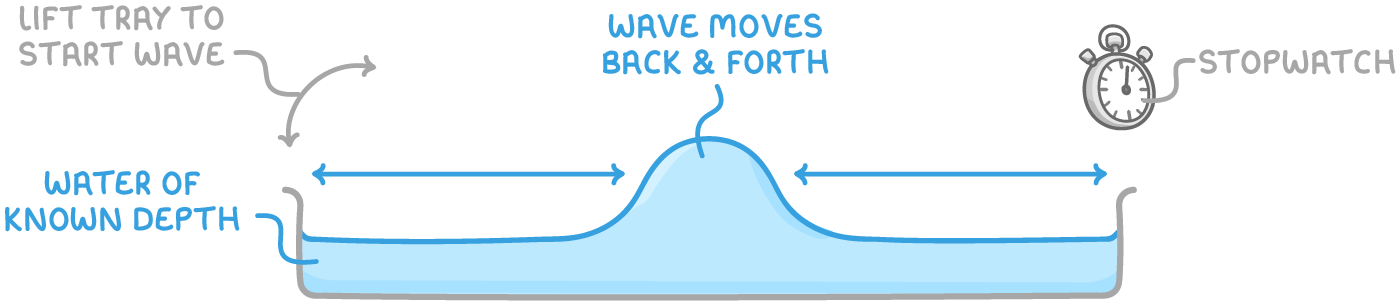
- Fill the tray - Stand a rectangular tray on a level bench and fill it with water to a depth of 0.5 cm, measured with a ruler.
- Measure the tray - Measure its length, because the pulse is timed over three lengths.
- Start a pulse - Lift one end of the tray a few centimetres and set it straight back down.
- Time three tray lengths - Start a stopwatch as the pulse sets off, and stop it when the pulse has travelled to the far end, back, and to the far end again.
- Repeat - Time five pulses at this depth, and find the mean time.
- Change the depth - Add water to raise the depth in 0.5 cm steps up to 3.0 cm, and repeat at each depth.
Safety
- Spilt water - Keep the tray away from the edge of the bench and from mains sockets, and mop up spills straight away, because a wet floor is slippery.
Worked example - Calculating wave speed
A student used a tray 50.0 cm long. At each depth, they timed a wave pulse over three tray lengths five times, and recorded the mean time.
| Depth (cm) | 0.5 | 1.0 | 1.5 | 2.0 | 2.5 | 3.0 |
|---|---|---|---|---|---|---|
| Mean time over three tray lengths (s) | 6.80 | 4.80 | 3.90 | 3.40 | 3.00 | 2.75 |
Calculate the speed at each depth, and describe how the speed depends on the depth.
Step 1 - Work out the distance travelled
Distance = 3 × 50.0 cm = 150 cm
Step 2 - Calculate the speed at each depth
Use with = 150 cm.
- At 0.5 cm, the speed is 150 ÷ 6.80 = 22.1 cm/s.
- At 1.0 cm, the speed is 150 ÷ 4.80 = 31.3 cm/s.
- At 1.5 cm, the speed is 150 ÷ 3.90 = 38.5 cm/s.
- At 2.0 cm, the speed is 150 ÷ 3.40 = 44.1 cm/s.
- At 2.5 cm, the speed is 150 ÷ 3.00 = 50.0 cm/s.
- At 3.0 cm, the speed is 150 ÷ 2.75 = 54.5 cm/s.
Step 3 - Plot speed against depth
Plot the speed on the y-axis against the depth on the x-axis. The points lie on a curve that gets less steep as the depth increases.
Step 4 - Describe the relationship
The speed increases with depth, but it isn't directly proportional to the depth. The speed is proportional to the square root of the depth, so a graph of against depth is a straight line through the origin.
Common exam questions
Question 1
Why is the pulse timed over three tray lengths rather than one?
A single length takes about a second or less, which isn't much longer than a person's reaction time. Timing a longer journey makes the reaction-time error a much smaller share of the reading.
Question 2
Why is the wave started by lifting one end of the tray and setting it down, rather than by hand?
It sends one clean pulse along the whole width of the tray. A hand in the water makes several waves in different directions, with no single crest to follow.
Question 3
Why is the tray stood on a level bench?
So the depth is the same everywhere in the tray. On a slope the water would be deeper at one end, and the pulse would travel at different speeds along its journey.
Question 4
Explain why waves slow down as they approach a beach.
The water gets shallower towards the shore, and the speed of a water wave depends on the depth. Shallower water means a slower wave.