11.3 - I-V Characteristics of Components
The experiment
Aim
To obtain the voltage-current characteristic graph of a metal wire at constant temperature, showing that the voltage across it and the current through it are proportional, and then to do the same for a filament lamp and show that its resistance rises as the current rises.
Background
- Resistance is how strongly a component opposes the current through it. It's linked to the voltage and the current by .
- A metal wire at a steady temperature keeps the same resistance, so the voltage is directly proportional to the current. This is Ohm's law.
- A filament lamp heats up as the current rises, and its resistance goes up with it.
- You can't measure resistance directly, but you can measure the voltage and the current, and work it out from them.
- So in this practical you measure the current at a range of voltages, and plot voltage against current. A straight line through the origin shows a constant resistance.
Variables
- Independent variable - The voltage across the component.
- Dependent variable - The current through the component.
- Control variables - The component, the meters, and the temperature of the wire.
Method
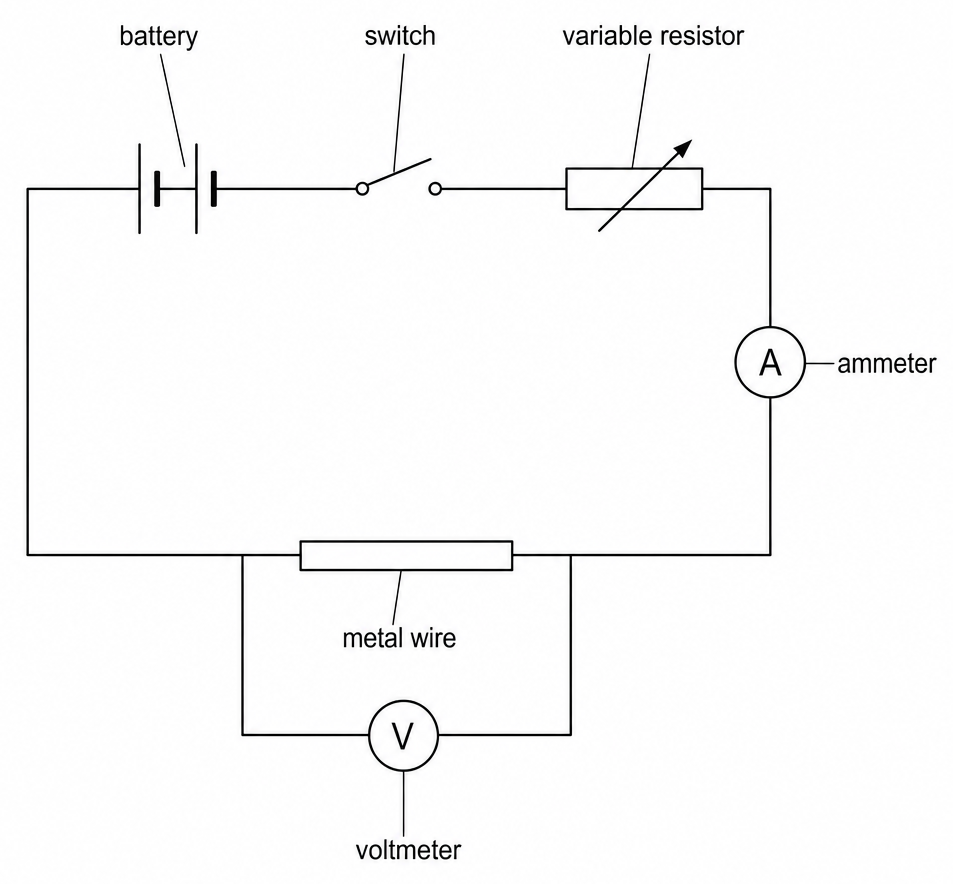
- Build the circuit - Connect the metal wire in series with an ammeter, a variable resistor, a switch, and the power supply, and connect a voltmeter in parallel across the wire.
- Take the first reading - Close the switch, set the voltage to 1.0 V with the variable resistor, and record the current. Then open the switch straight away.
- Take more readings - Wait about two minutes for the wire to cool, then repeat in 1.0 V steps up to 6.0 V, opening the switch and waiting after every reading.
- Do a second trial - Go through the whole range again, then work out the mean current and voltage ÷ current at each voltage.
- Plot the graph - Voltage on the y-axis against mean current on the x-axis, with a line of best fit.
- Test a filament lamp - Replace the wire with a filament lamp and repeat the whole run.
Safety
- Hot components - The wire can get hot enough to burn without looking any different, and so can a filament lamp. Keep the voltage low, and let everything cool before you touch it or change the circuit.
Worked example - Resistance of a metal wire
A student tested a metal wire twice, opening the switch between readings.
| Voltage (V) | 1.0 | 2.0 | 3.0 | 4.0 | 5.0 | 6.0 |
|---|---|---|---|---|---|---|
| Current, trial 1 (A) | 0.19 | 0.41 | 0.59 | 0.81 | 0.99 | 1.21 |
| Current, trial 2 (A) | 0.21 | 0.39 | 0.61 | 0.79 | 1.01 | 1.19 |
They then tested a filament lamp, which gave 0.20 A at 1.0 V and 0.60 A at 6.0 V.
Work out the mean current and voltage ÷ current at each voltage, find the resistance from the graph, and say what the results show. Then find how the lamp's resistance changes.
Step 1 - Work out the mean current at each voltage
Add the two trials and divide by 2.
- At 1.0 V, (0.19 + 0.21) ÷ 2 = 0.20 A.
- At 2.0 V, (0.41 + 0.39) ÷ 2 = 0.40 A.
- At 3.0 V, (0.59 + 0.61) ÷ 2 = 0.60 A.
- At 4.0 V, (0.81 + 0.79) ÷ 2 = 0.80 A.
- At 5.0 V, (0.99 + 1.01) ÷ 2 = 1.00 A.
- At 6.0 V, (1.21 + 1.19) ÷ 2 = 1.20 A.
Step 2 - Work out voltage ÷ current at each voltage
1.0 ÷ 0.20, 2.0 ÷ 0.40, 3.0 ÷ 0.60, 4.0 ÷ 0.80, 5.0 ÷ 1.00, and 6.0 ÷ 1.20 all give 5.0 Ω.
The ratio is the same at every voltage, so the voltage is directly proportional to the current. This confirms Ohm's law.
Step 3 - Find the resistance from the gradient
Plot voltage on the y-axis against mean current on the x-axis. The points lie on a straight line through the origin.
With voltage on the y-axis, the gradient is , which is the resistance itself.
Step 4 - Find the lamp's resistance as the current rises
The resistance doubles, because the filament heats up as the current increases. On a voltage-current graph, the line curves upwards and gets steeper.
Common exam questions
Question 1
A student plots the wire's results with current on the y-axis instead. What does the gradient give?
Current ÷ voltage, which is 1 ÷ resistance, not the resistance itself.
Question 2
Why is the ammeter connected in series with the wire, but the voltmeter in parallel with it?
The ammeter needs the same current through it as the wire, which only happens in series. The voltmeter measures the voltage between the wire's two ends, so it goes across it.
Question 3
Why is the switch opened between readings?
A current warms the wire, and a warmer wire has a higher resistance. Opening the switch and waiting lets it cool back to room temperature, so its temperature doesn't change the results.
Question 4
Why is a variable resistor included in the circuit?
Changing its resistance changes the current, and so the voltage across the wire. That gives a range of readings without changing the power supply.
Question 5
Why is each reading taken twice and a mean found?
Each reading has a small random error, from reading the meter and from the wire's temperature. The mean of two trials reduces the effect of that error.