10.2 - Orbits
Gravity provides the force that creates orbits
- Planets orbit the Sun, and moons and artificial satellites orbit planets, in almost circular orbits.
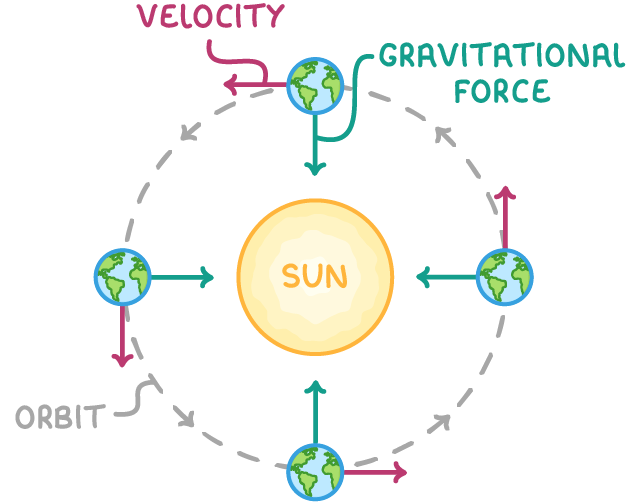
- An object moving in a circle is constantly changing direction, so even at a constant speed its velocity is constantly changing.
- A changing velocity means the object is accelerating, which requires a resultant force.
- This force acts towards the centre of the circle.
Gravity provides the inward force
- For an orbiting object, this inward force is provided by gravity:
- The Sun's gravitational pull keeps planets and comets in orbit.
- A planet's gravitational pull keeps moons and artificial satellites in orbit.
- Because the object is already moving, the gravitational pull doesn't pull it straight in - it constantly bends its path into a circle.
Natural and artificial satellites and their uses
- A satellite is an object that orbits a larger object in space.
- The Moon is a natural satellite of the Earth; satellites placed into orbit by humans are artificial satellites.
Uses of artificial satellites
- Communications - Transmitting television broadcasts, phone calls, and internet data
- Navigation - Providing GPS signals for vehicles and smartphones
- Weather forecasting - Monitoring clouds, temperatures, and storms
- Earth observation - Tracking climate change, agricultural land use, and pollution
- Astronomy - Housing telescopes (like the Hubble Space Telescope) above the atmosphere to avoid atmospheric distortion
- Military - Surveillance and reconnaissance
TermDefinition
SatelliteAn object that orbits a larger object in space.
Artificial satelliteA satellite that humans have built and put into orbit.