10.4 - The Big Bang
The expanding Universe points to a beginning
Nearly all galaxies are moving away from one another, and the more distant a galaxy is, the faster it is moving away.
The balloon model
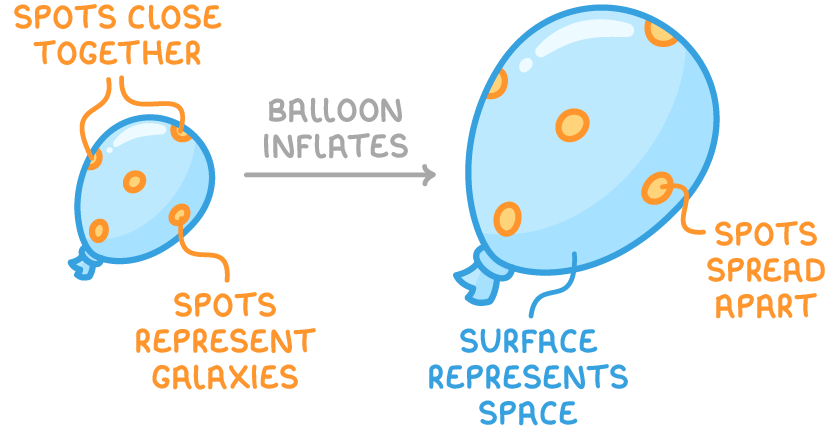
- Imagine a balloon with spots painted on it: as it inflates, the rubber stretches and every spot moves further from every other spot.
- The balloon's surface represents space itself and each spot represents a galaxy.
- Space is stretching and carrying the galaxies apart, so the whole Universe is expanding.
Working backwards
- Because galaxies are moving apart now, in the distant past they must have been much closer together.
- Following this backwards leads to the conclusion that the Universe began from a single, extremely small region - the starting point for the Big Bang theory.
The Big Bang theory
- The Big Bang theory is the accepted explanation of how the Universe began.
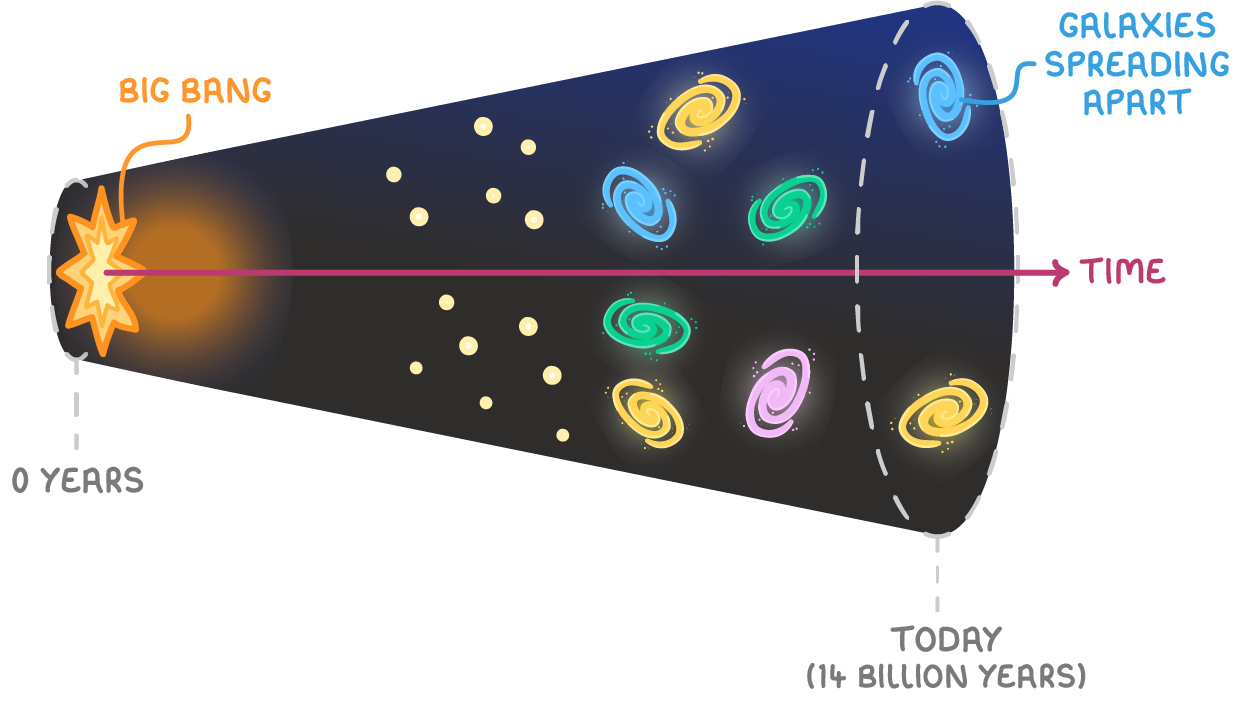
- All the matter and energy in the Universe was once concentrated into a single, tiny region that was extremely hot and dense.
- It then began to expand rapidly - the Big Bang - and space has been expanding ever since.
The age of the Universe
- The theory gives the Universe a finite age.
- Working back from the expansion rate gives an age of roughly 14 billion years (about 13.8 billion years).
TermDefinition
Big Bang theoryThe theory that all the matter in the Universe was once packed into a very small, extremely hot and dense region, and that the Universe has been expanding from it ever since.