5.1 - Developing the Model of the Atom
The plum pudding model
- In 1897, J. J. Thomson discovered the electron - a tiny, negatively charged particle.
- This showed atoms are not indivisible spheres, but contain smaller charged parts.
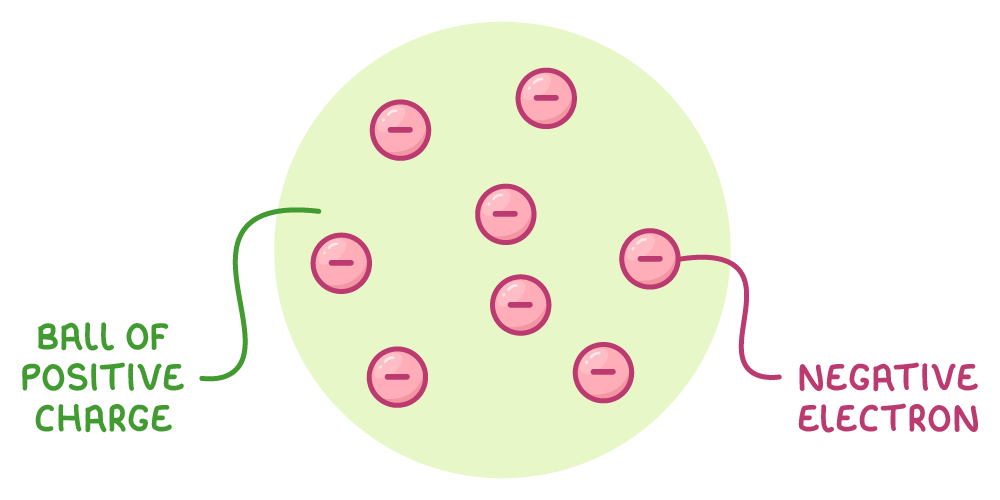
- Thomson proposed the plum pudding model:
- The atom is a ball of positive charge.
- Tiny negative electrons are embedded inside it.
Bohr's energy levels
- Rutherford's model had electrons in a "cloud" around the nucleus, but electrons in this arrangement would spiral inwards, causing the atom to collapse.
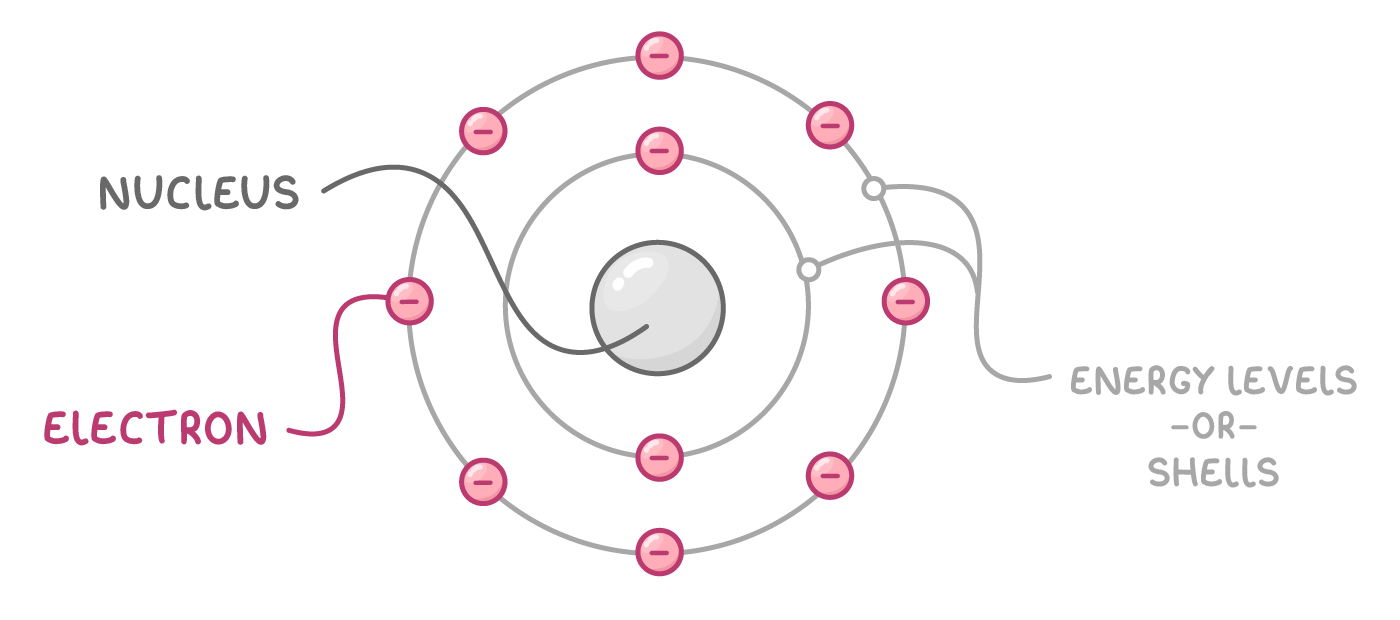
- Niels Bohr adapted the model:
- Electrons orbit the nucleus only at fixed distances, called energy levels or shells.
- Electrons can exist in these allowed shells, but not in between them.
- Bohr's theoretical calculations matched experimental observations.
TermDefinition
ElectronA tiny, negatively charged particle found in atoms.
Plum pudding modelAn early model of the atom as a ball of positive charge with negative electrons embedded in it.
Energy levelA fixed distance from the nucleus where electrons can orbit. It is also called a shell.