4.14 - Transfer Between KE & GPE
Falling and rising change energy between two forms
- When an object falls, its gravitational potential energy changes into kinetic energy - it loses height and speeds up.
- When an object rises - thrown upwards or rolled up a slope - the change runs the other way, from kinetic energy to gravitational potential energy - it slows down as it gains height.
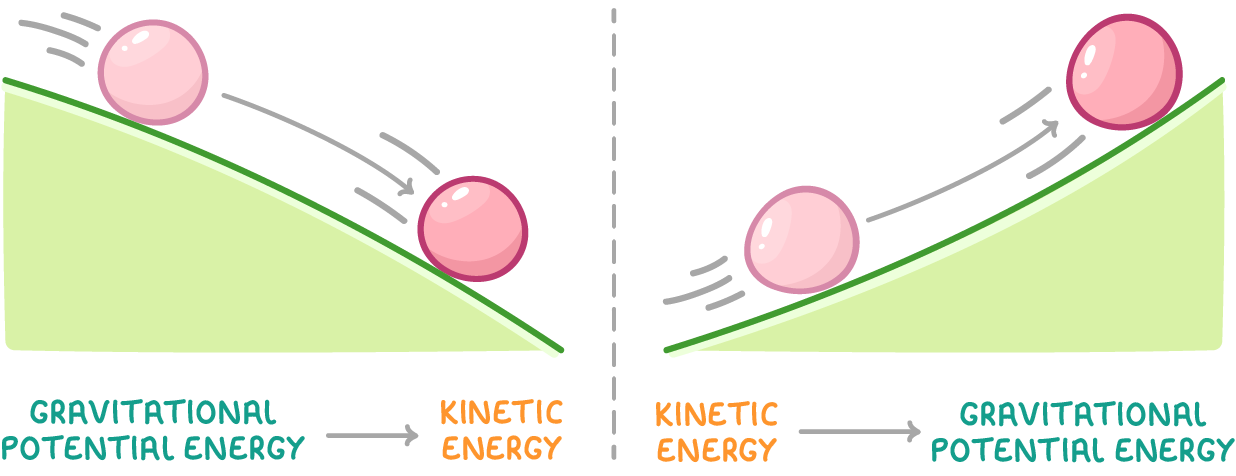
With no air resistance
With no air resistance, none of the energy changes into other forms, so the amount of one form lost equals the amount gained by the other:
Gravitational potential energy lost = kinetic energy gained
Air resistance changes some energy to other forms
- As an object moves through the air, air resistance changes some energy into thermal energy (heat) in the object and the surrounding air.
- The kinetic energy gained is therefore less than the gravitational potential energy lost.
Speed of a falling object from conservation of energy
When an object falls freely with no air resistance, all the gravitational potential energy lost changes into kinetic energy:
Rearranging the kinetic energy equation gives the speed:
Gravitational field strength on Earth is taken as 10 N/kg. Always use the value given in the question.
Worked example - Speed of a falling object
A stationary stone of mass 3.0 kg is dropped from a height of 5.0 m. Taking N/kg and ignoring air resistance, find the kinetic energy it gains and its speed just before it lands.
Step 1 - Find the gravitational potential energy lost
Step 2 - All of this energy changes into kinetic energy
With no air resistance, the kinetic energy gained is the full 150 J:
Step 3 - Rearrange the kinetic energy equation to find the speed
So the stone gains 150 J of kinetic energy and reaches a speed of 10 m/s just before it lands.