2.4 - Newton's 1st & 2nd Laws
Newton's First Law - Resultant force changes motion
- Newton's First Law - If the resultant force on an object is zero, its velocity doesn't change:
- A stationary object stays stationary.
- A moving object continues at the same velocity (same speed and direction).
- When an object is stationary or moving at a constant velocity, the forces on it are balanced.
- Velocity only changes if the forces are unbalanced, giving a non-zero resultant force that causes an acceleration in the direction of the force.

A non-zero resultant force can cause an object to:
- start moving
- stop moving
- speed up
- slow down
- change direction
Newton's Second Law - Acceleration and resultant force
- The larger the resultant force on an object, the more it accelerates - force and acceleration are directly proportional ().
- Acceleration is inversely proportional to mass: for a fixed resultant force, a larger mass accelerates less than a smaller one.
Formula for Newton's Second Law
Where:
- = Resultant force, in newtons (N)
- = Mass, in kilograms (kg)
- = Acceleration, in metres per second squared (m/s2)
is always the resultant force, found by adding or subtracting the forces acting along the same line.
Worked example - Acceleration of a car
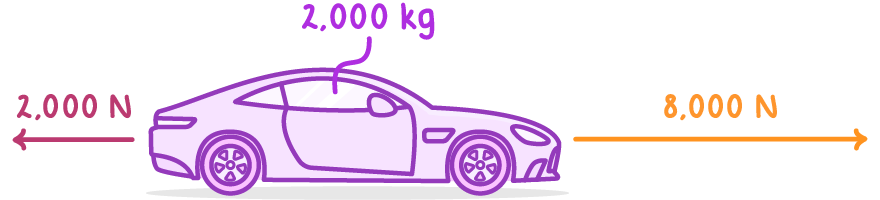
A car of mass 2,000 kg has an engine providing a driving force of 8,000 N. The drag force on the car is 2,000 N. Find its acceleration.
Step 1 - Work out the resultant force
The driving force and drag force act along the same line in opposite directions, so subtract them.
Step 2 - Rearrange F = ma for acceleration
Step 3 - Substitution and calculation
The car accelerates at 3 m/s2 in the direction of the resultant force.
Demonstrating Newton's First Law
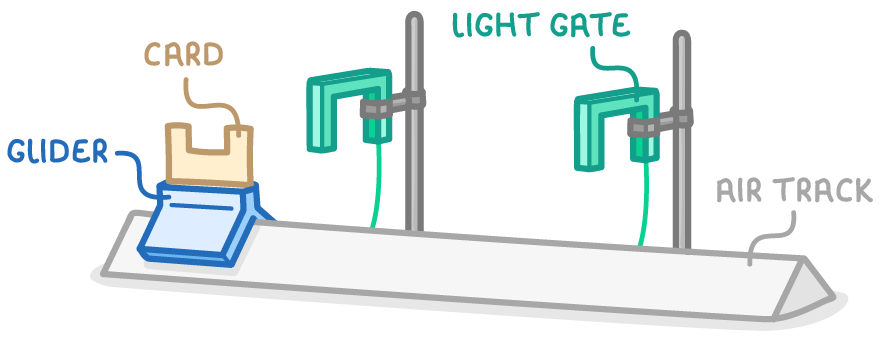
Newton's First Law can be demonstrated with a near-frictionless linear air track, allowing a glider to move with almost no resultant force acting on it.
Method
- Set the air track on a flat bench and level it using the adjustable feet.
- Measure the length of the interrupt card on the glider and enter it into the data logger.
- Connect two light gates to measure the glider's velocity at two points along the track.
- Switch on the blower to minimise friction, then give the glider a gentle push so it passes through both light gates.
- Compare the velocity at the two light gates.
Result
The velocity doesn't change between the two light gates. With no resultant force, the glider maintains a constant velocity, as Newton's First Law predicts.