8.3 - V = IR Equation & I-V Graphs
Formula linking p.d., current and resistance
Where:
- = Potential difference, in volts (V)
- = Current, in amperes (A)
- = Resistance, in ohms (Ω)
The greater the resistance of a component, the smaller the current that flows through it for a given potential difference across it.
Finding the resistance
The equation can be rearranged to find the resistance of a component from measured values of potential difference and current:
Worked example - Current through a resistor
A 5.0 Ω resistor in a circuit has a potential difference of 9.0 V across it. Calculate the current through the resistor.
Step 1 - Identify the values
- Potential difference: V
- Resistance:
Step 2 - Rearrange V = IR to make current the subject
Step 3 - Substitution and calculation
The current through the resistor is 1.8 A.
Ohmic conductors and the V-I characteristic
- A V-I characteristic is a graph showing how the voltage (also called the potential difference) across a component changes as the current through it is increased - voltage on the y-axis, current on the x-axis.
- The resistance of an ohmic conductor, such as a fixed resistor or a metal wire, does not change with the current through it - as long as its temperature stays constant.
- For an ohmic conductor at constant temperature, the current is directly proportional to the voltage across it. This is commonly called Ohm's law.
Shape of the graph
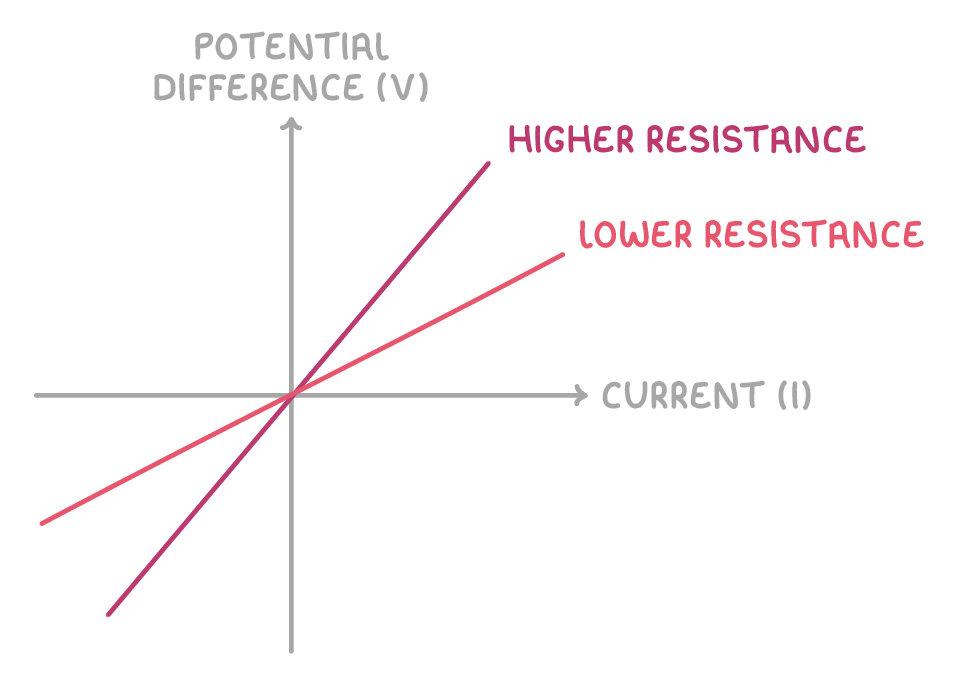
- A component whose resistance stays constant gives a straight line through the origin.
- The steeper the line, the higher the resistance.
Finding the resistance from the graph
- Read the voltage and current at a point and use .
- For a straight line through the origin, the resistance is the gradient of the line.
V-I characteristic of a filament lamp
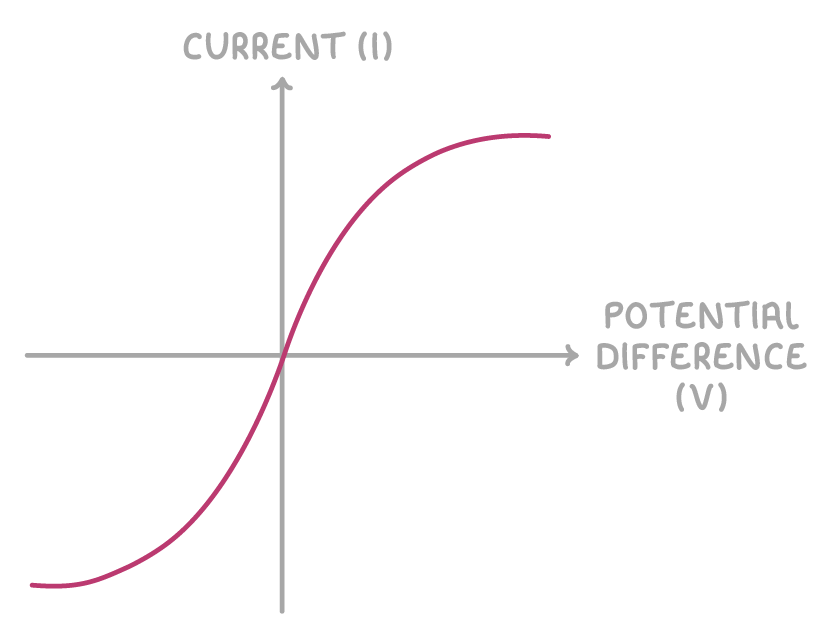
- Some components do not have a constant resistance, so their V-I characteristic (voltage on the y-axis, current on the x-axis) is a curve rather than a straight line. The filament lamp is one of these.
- As the current through a filament lamp increases, the free electrons collide more often with the atoms of the filament and transfer energy to them, so the filament heats up.
- As its temperature rises, the resistance increases.
- The resistance at any point is the ratio of the voltage to the current (), and this ratio gets larger as the current increases.
- Each extra amp of current needs a bigger increase in voltage, so the characteristic gets steeper as the current increases - giving a curve.
- The drawing shows the same curve with the axes the other way round (current up the side), so on it the curve flattens off instead.
TermDefinition
Ohmic conductorA component whose resistance stays constant as the current through it changes, provided its temperature is constant.
Ohm's lawThe rule that the current through an ohmic conductor at constant temperature is directly proportional to the voltage across it.