2.10 - Centre of Mass
Centre of gravity
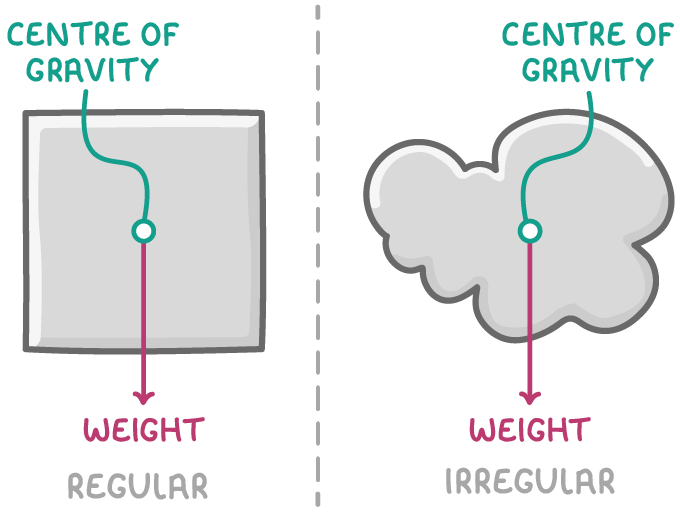
- The centre of gravity of an object is the point through which its entire weight can be considered to act.
- Because the whole weight acts at this point, it's also the point where the object's mass can be thought of as concentrated.
- For a regular, symmetrical shape, the centre of gravity is at its geometric centre (e.g. the centre of a uniform sphere), while an irregular shape has one too, even though symmetry can't be used to find it.
Centre of gravity of regular shapes
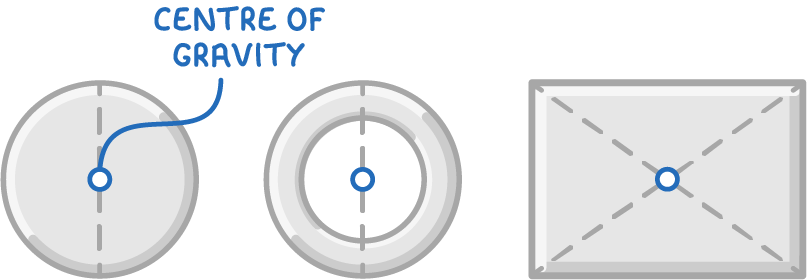
For a regularly shaped object, the centre of gravity sits at its point of symmetry:
- Disc - At the centre of the circle.
- Ring - At the centre of the ring, even though there's no material there.
- Rectangle (such as a rectangular lamina) - At its geometric centre, where the diagonals cross.
Finding the centre of gravity by suspension
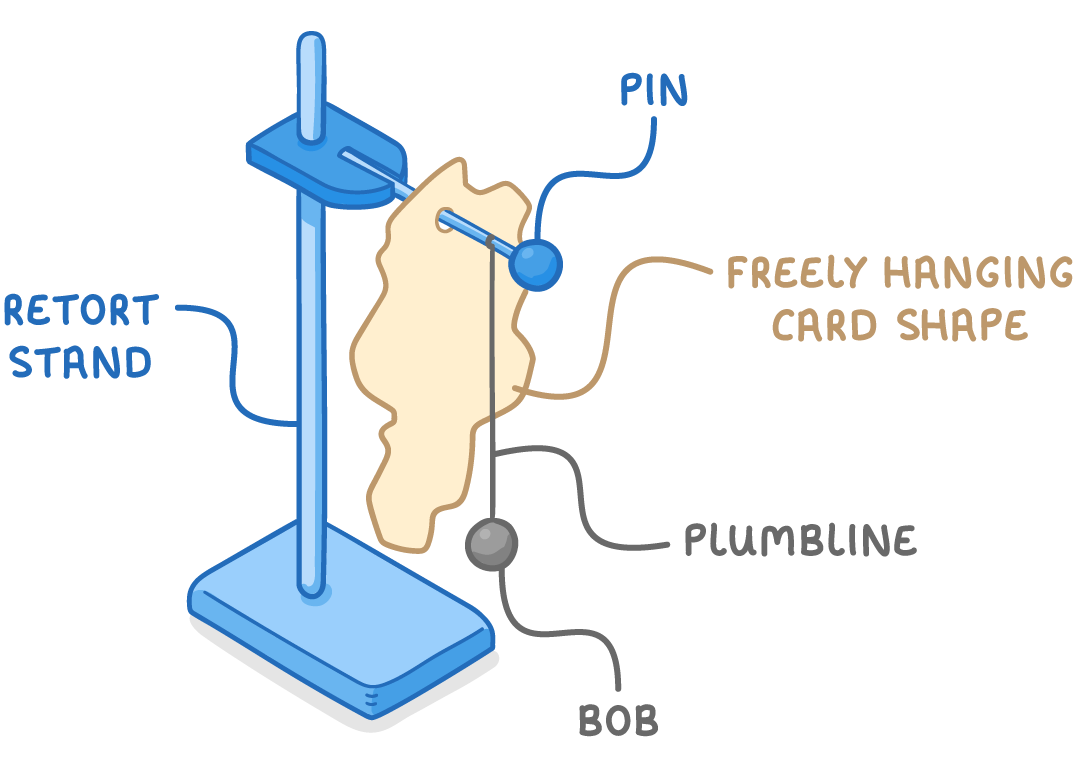
- When an object is hung so it can swing freely, it comes to rest with its centre of gravity vertically below the point of suspension.
- If its centre of gravity is not directly below the pivot, the weight acts at a perpendicular distance from that point, producing a moment that turns the object until the weight acts in line with the pivot.
Locating the centre of gravity of a flat shape
This is used to find the centre of gravity of a flat shape (a plane lamina):
- Suspend the shape from a pivot so it can swing freely, and hang a plumb line from the same point. Wait until both stop moving.
- Draw a line on the shape along the plumb line.
- Repeat with the shape suspended from a different pivot point, drawing a second line.
- The centre of gravity is where the lines cross.
Stability and the three types of equilibrium
An object is in equilibrium when the forces and moments acting on it are balanced.
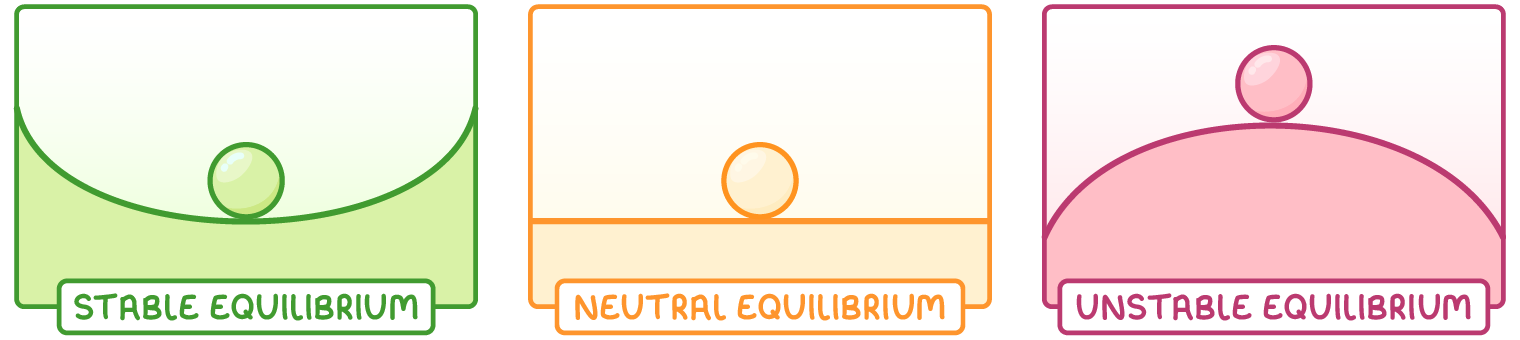
The three types of equilibrium
- Stable equilibrium - A small displacement causes the object to return to its original position, because the displacement raises its centre of gravity.
- Unstable equilibrium - A small displacement causes the object to move further away from its original position and topple, which lowers its centre of gravity.
- Neutral equilibrium - A small displacement leaves the object in equilibrium in its new position, keeping its centre of gravity at the same height (e.g. a ball rolling on flat ground).
Maximum stability
- For maximum stability, the centre of gravity should be as low as possible and the base as wide as possible.
- This allows an object to be tilted further before the line of action of its weight falls outside the base (e.g. tractors have a wide wheelbase so they don't overturn on steep slopes).
TermDefinition
Centre of massThe point through which the whole weight of an object can be thought of as acting. It is also called the centre of gravity.
EquilibriumThe state of an object when the forces acting on it are balanced, so the resultant force is zero. For an object that can turn, the moments must also balance, so there is no resultant moment.
Stable equilibriumA state where a small displacement raises an object's centre of gravity, causing it to return to its original position.
Unstable equilibriumA state where a small displacement lowers an object's centre of gravity, causing it to topple.
Neutral equilibriumA state where, if an object is moved slightly, its centre of gravity stays at the same height, so it stays in its new position.