8.9 - Wiring Plugs & Switches
A mains cable has three wires
Most appliances connect to the mains by a three-core cable - three separate wires, each in coloured plastic insulation.
The job of each wire
- Live wire (brown) - Carries the alternating potential difference from the mains, at about 230 V.
- Neutral wire (blue) - Completes the circuit, carrying current back out. It stays at about 0 V.
- Earth wire (green and yellow stripes) - A safety wire connected to the metal casing to stop it becoming live. It carries current only when there's a fault, and sits at 0 V.

Potential differences between the wires
- Live to neutral = about 230 V (the supply p.d.).
- Live to earth = about 230 V.
- Neutral to earth = 0 V, because both are at 0 V.
The switch in a socket is fitted in the live wire so that switching off isolates the appliance from the high voltage.
Wiring a three-pin plug
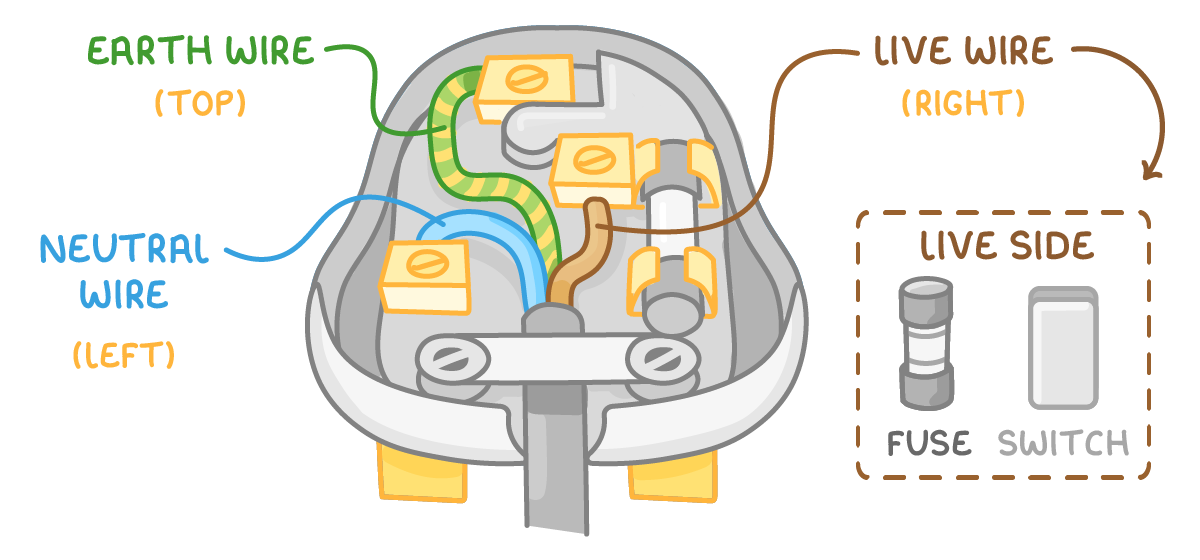
- Each of the three wires connects to its own pin, held by a terminal.
- A cable grip clamps the outer cable so the wires aren't pulled loose.
Which wire goes where
With the pins facing away from you:
- Blue neutral wire - Connects to the left-hand pin.
- Brown live wire - Connects to the right-hand pin.
- Green and yellow earth wire - Connects to the top pin.
The switch and fuse are on the live side
- The switch and fuse are always placed in line with the live wire.
- The live wire is at about 230 V, while the neutral side sits at roughly 0 V, so breaking the live side cuts the appliance off from the high voltage.
- A one-way switch is a simple make-or-break switch: turning it on closes the contacts to complete the circuit; turning it off separates them to break it.
Two-way switches
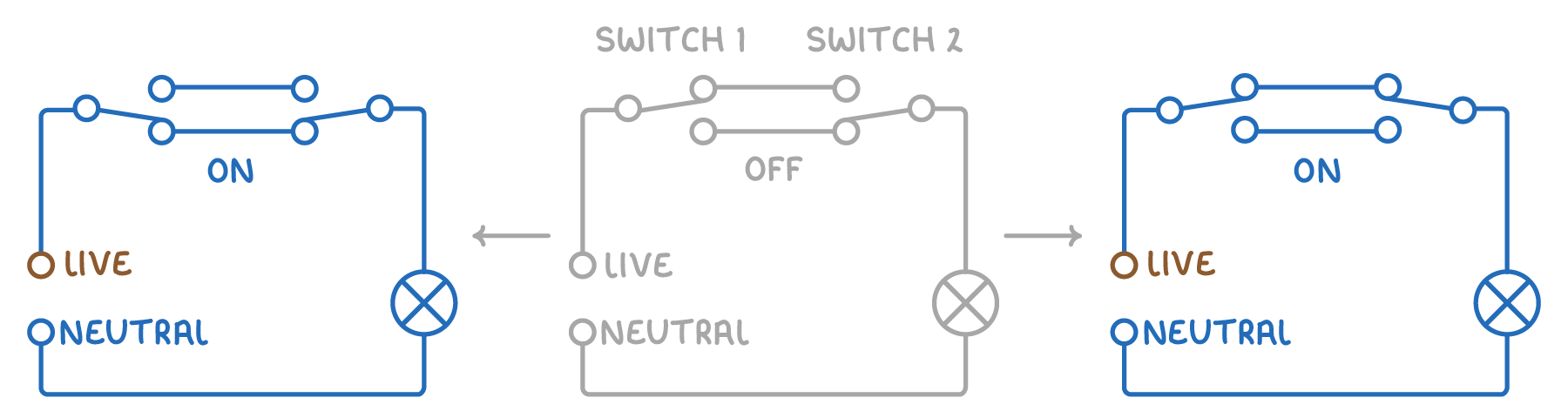
- A two-way switch lets a single light be turned on or off from two different places, such as the top and bottom of a staircase.
- It uses two switches wired together so that flipping either switch reverses the state of the circuit.
- Neither switch has a fixed on or off position on its own.
How it controls the light
- The light is on when both switches are set the same way, completing the circuit.
- Flipping either switch breaks the circuit and turns the light off.
- Flipping either switch again completes the circuit and turns the light back on.
TermDefinition
Live wireThe brown wire in a mains cable that carries the alternating potential difference from the supply.
Neutral wireThe blue wire in a mains cable that completes the circuit and sits at about 0 V.
Earth wireThe green and yellow safety wire that connects the metal case of an appliance to the ground, so a current can flow safely to earth if there is a fault.
Three-core cableA cable connecting an appliance to the mains that contains separate live, neutral and earth wires.