20.4 - How the Electric Motor Works
Forces on a coil produce a turning effect
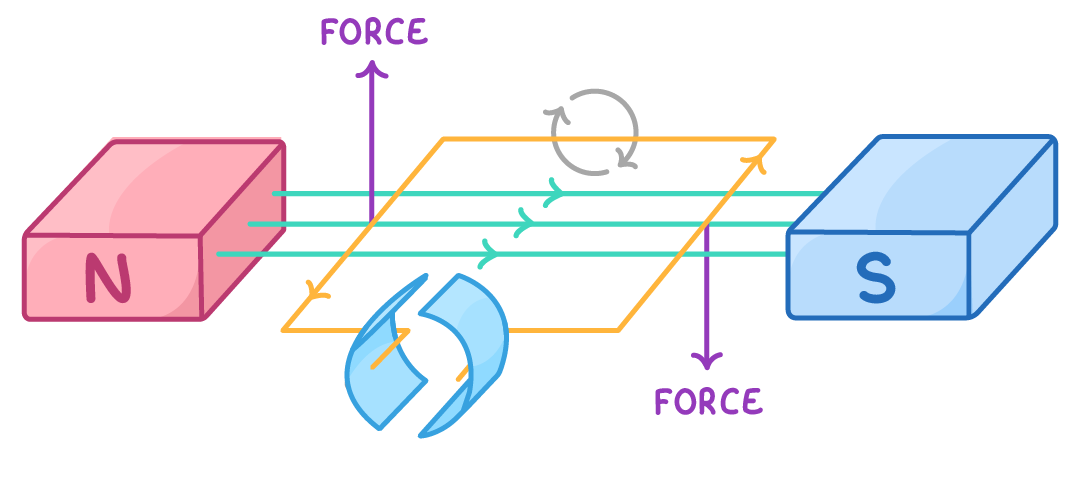
- A simple direct current (d.c.) motor is a coil of wire sitting between the poles of a magnet, free to turn on a spindle.
- When current flows, each side arm of the coil carries current in the opposite direction to the other.
- The motor effect pushes one side arm up and the other side arm down.
- These two forces act in opposite directions on opposite sides of the spindle, producing a turning effect so the coil rotates.
Making a motor turn faster
The turning effect on the coil is increased, making the motor turn faster, by:
- Increasing the current in the coil
- Increasing the number of turns on the coil
- Increasing the strength of the magnetic field
The motor effect:
- The side arms feel a force because they're current-carrying conductors at right angles to a magnetic field (the motor effect).
- The direction of each force is found with Fleming's left-hand rule.
TermDefinition
Direct current (d.c.) motorA motor with a coil of wire between the poles of a magnet. The coil rotates when a direct current passes through it.