18.1 - Components
How resistance depends on length and area
- The resistance of a wire depends on the material it's made from, its length, and its cross-sectional area.
- The longer the wire, the greater its resistance.
- The greater the cross-sectional area, the smaller its resistance.
- A long, thin wire therefore has a higher resistance than a short, thick wire of the same material.
Light-dependent resistors (LDRs)
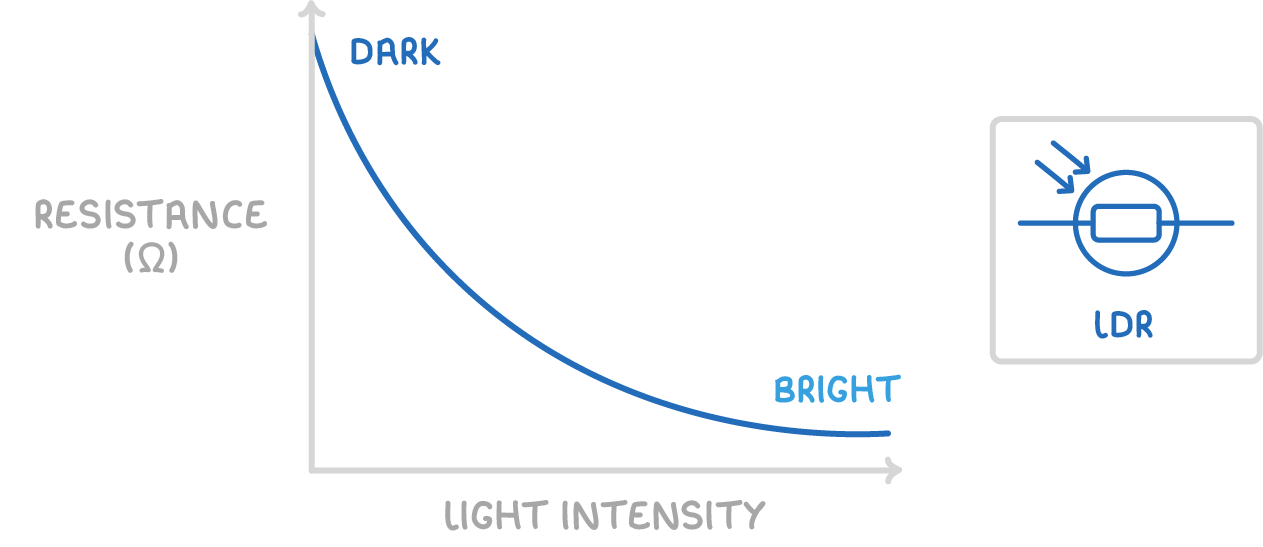
- A light-dependent resistor (LDR) is a resistor whose resistance depends on the intensity of light falling on it.
- In darkness, its resistance is highest.
- As the light gets brighter, its resistance falls.
- Common applications: automatic night lights, outdoor lighting, and burglar detectors.
Thermistors
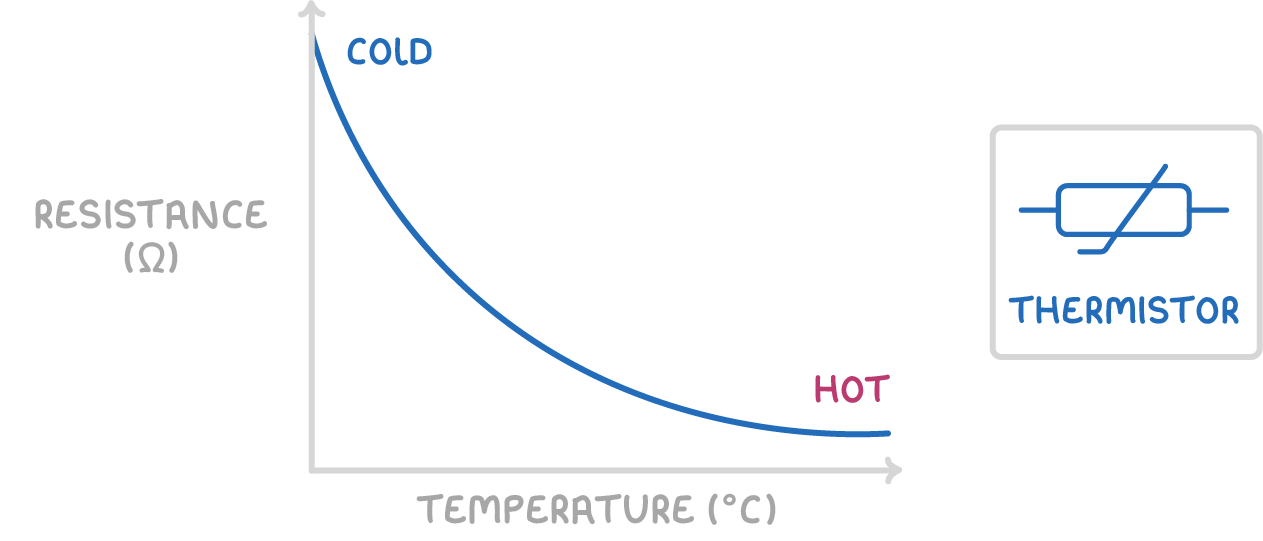
- A thermistor is a resistor whose resistance depends on temperature.
- In cold conditions, its resistance is high.
- As the temperature rises, its resistance falls.
- Because resistance falls as temperature rises, it's called a negative temperature coefficient (NTC) thermistor.
- Common applications: car engine temperature sensors, thermostats, irons, and fire alarms.
TermDefinition
Light-dependent resistor (LDR)A resistor whose resistance decreases as the intensity of light falling on it increases.
ThermistorA resistor whose resistance decreases as its temperature increases.