3.11 - Total Internal Reflection
Total internal reflection depends on the critical angle
- Under the right conditions, light meeting a boundary is reflected entirely back into the material it came from. This is total internal reflection.
- Total internal reflection can only happen when:
- Light travels from a denser material (such as glass or water) towards a less dense material (such as air).
- The angle of incidence is greater than the critical angle.
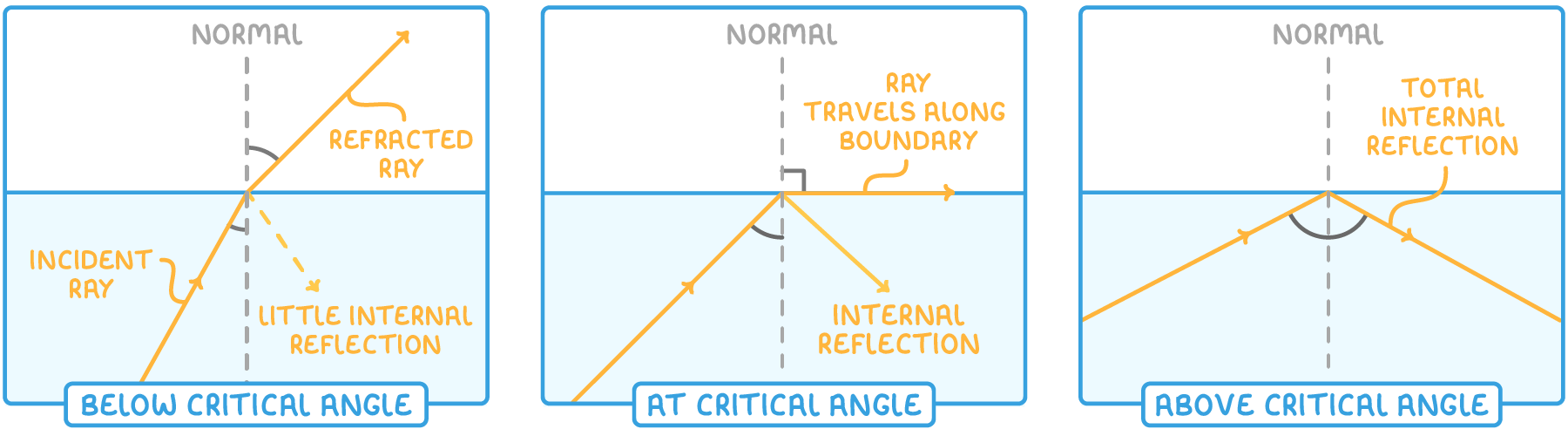
- The critical angle () is the angle of incidence in the denser material that produces an angle of refraction of 90 degrees in the less dense material. For glass to air, this is about 42 degrees.
What happens at each angle of incidence
- Below the critical angle - Most light refracts out into the less dense material, and a small amount is internally reflected.
- At the critical angle - The refracted ray travels along the boundary, and there's strong internal reflection.
- Above the critical angle - No light escapes; it's all reflected back into the material. This is total internal reflection.
Optical fibres use total internal reflection
- Optical fibres carry light signals using total internal reflection.
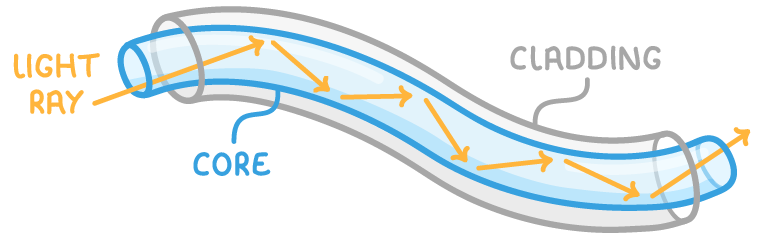
- A fibre has a dense central core surrounded by cladding of a lower refractive index.
How light stays in the core
- Light enters the core at a shallow angle.
- Each time it meets the core-cladding boundary, it strikes at an angle greater than the critical angle, so it totally internally reflects and bounces along inside the core.
- If a fibre is bent too sharply, light can meet the boundary below the critical angle and escape by refraction into the cladding.
Use in telecommunications
- Used in broadband internet and telephone cables, where data is encoded as pulses of light.
- An optical fibre carries far more information than a copper cable of the same diameter and produces higher quality signals.
Comparing optical fibres and satellites
Information can be sent over long distances through optical fibres or by transmitting signals to and from satellites.
Signal path and delay
- Electromagnetic waves travel faster through space than through glass.
- However, a satellite signal travels a much longer path (around 36,000 km each way for a geostationary satellite), whereas optical fibres follow direct ground routes.
- Overall, optical fibres usually have less time delay (latency).
Quality and security
Optical fibres offer higher data transfer rates, fewer errors, and greater security against interception than satellite links.
Installation and mobility
- Fibres require physical cables to be laid, which is expensive and difficult across remote terrain.
- Satellites need no ground cables, making them ideal for mobile communication and reaching remote areas.
TermDefinition
Total internal reflectionThe complete reflection of light back into a material when it meets a boundary with a material in which light travels faster (for example from glass into air), at an angle of incidence greater than the critical angle.
Critical angleThe angle of incidence in a denser material that produces an angle of refraction of exactly 90 degrees.