6.13 - Work Done
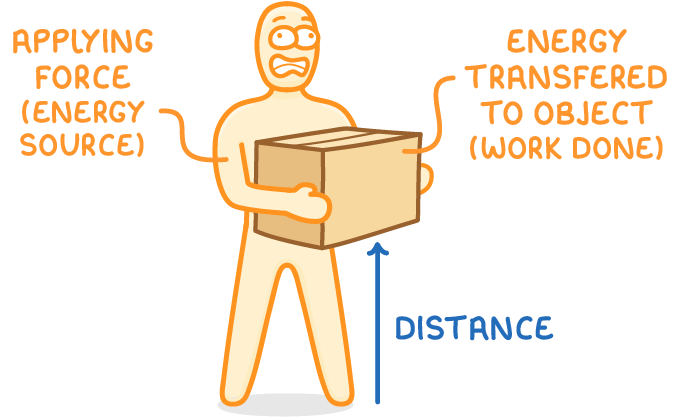
Work is done when a force moves an object
- When a force moves an object through a distance, energy is transferred and work is done on the object.
- "Work done" and "energy transferred" describe the same thing.
- Work is done whether the energy is transferred usefully (like lifting a load) or dissipated (like energy transferred to thermal stores by friction).
Work done against friction
- When an object is moved against a resistive force like friction, work is done against friction.
- Energy is transferred to thermal energy stores, raising the temperature of the object and its surroundings.
- The work done by the applied force equals the kinetic energy gained plus the energy transferred to thermal stores.
Work done is energy transferred
- When a force acts on an object and moves it, energy is transferred.
- The energy transferred by a force is called the work done.
- Doing work and transferring energy describe the same thing: the work done by a force equals the energy transferred.
Where the energy goes
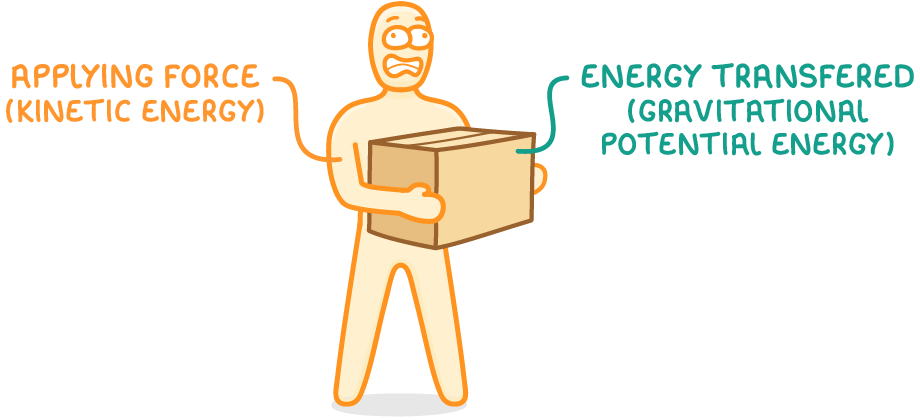
- An object can store energy because of its motion (kinetic energy) and its position (gravitational potential energy).
- When a force does work on an object, energy is transferred into or out of these stores.
Formula for work done
Where:
- = Work done, in joules (J) or newton metres (Nm)
- = Force, in newtons (N)
- = Distance moved along the line of action of the force, in metres (m)
Work done is calculated by multiplying the force by the distance moved along the line of action of the force.
One joule of work is done when a force of one newton moves an object a distance of one metre (1 J = 1 Nm).
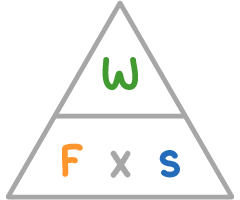
Cover the quantity you want to find to see how to calculate it.
Worked example - Work done pushing a crate
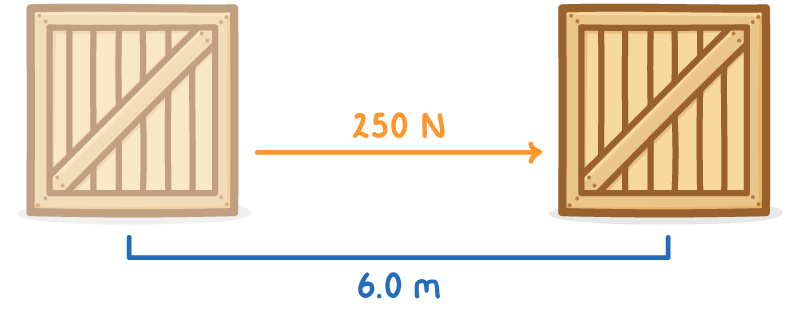
A crate is pushed 6.0 m across a level warehouse floor by a constant horizontal force of 250 N. Find the work done.
Step 1 - Formula
Step 2 - Substitution and calculation
The force and the movement are in the same direction, so all of the force does work. 1,500 J of energy is transferred from the person pushing the crate.
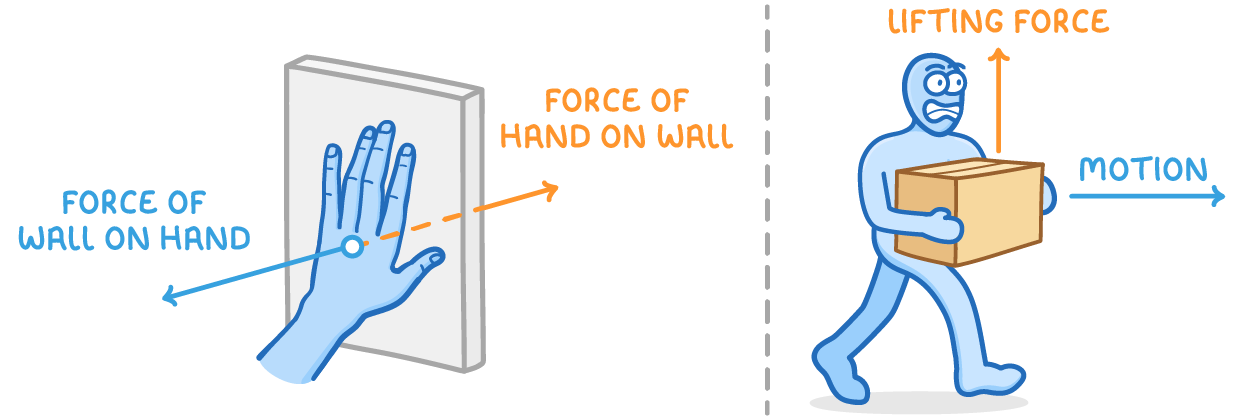
No work is done without motion in the force's direction
A force only does work if the object moves in the direction of that force. If there's no movement in that direction, no work is done by it.
- Pushing a wall that doesn't move - The distance moved is zero, so no work is done.
- Carrying a box while walking horizontally at constant speed - The lifting force points upwards while the box moves horizontally. Because the force is at right angles to the motion, it does no work on the box.
Worked example - Finding the resistive force
A person applies a constant pushing force of 15 N to move a box 5.0 m across the floor. The box gains 45 J of kinetic energy. Calculate the mean resistive force acting on the box.
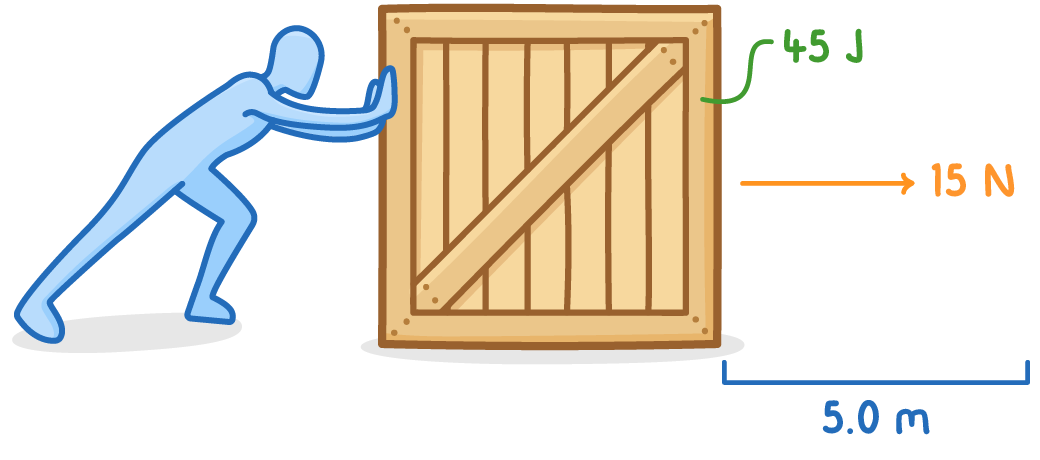
Step 1 - Find the total work done by the pushing force
Step 2 - Find the work done against friction
Work done against friction = total work done - kinetic energy gained
75 - 45 = 30 J
Step 3 - Find the mean resistive force
Rearrange :
The mean resistive force acting on the box is 6.0 N.