7.12 - Nuclear Fusion
What nuclear fusion is
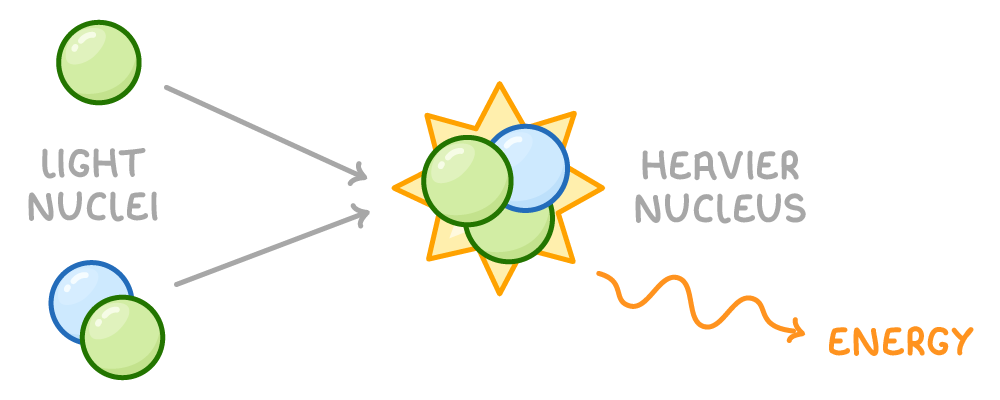
- Nuclear fusion is when two light nuclei collide at high speed and join together to make a single larger, heavier nucleus.
- For example, hydrogen nuclei fuse to form a helium nucleus.
- Fusion is the process that powers stars, including the Sun, releasing energy by fusing hydrogen into helium in their cores.
Mass is converted to energy in fusion
- When two light nuclei fuse, the heavier nucleus formed has slightly less mass than the two separate nuclei started with.
- That lost mass is converted into energy, released as radiation and the kinetic energy of the particles.
- For a given mass of fuel, fusion releases more energy than nuclear fission.
The deuterium-tritium fusion reaction
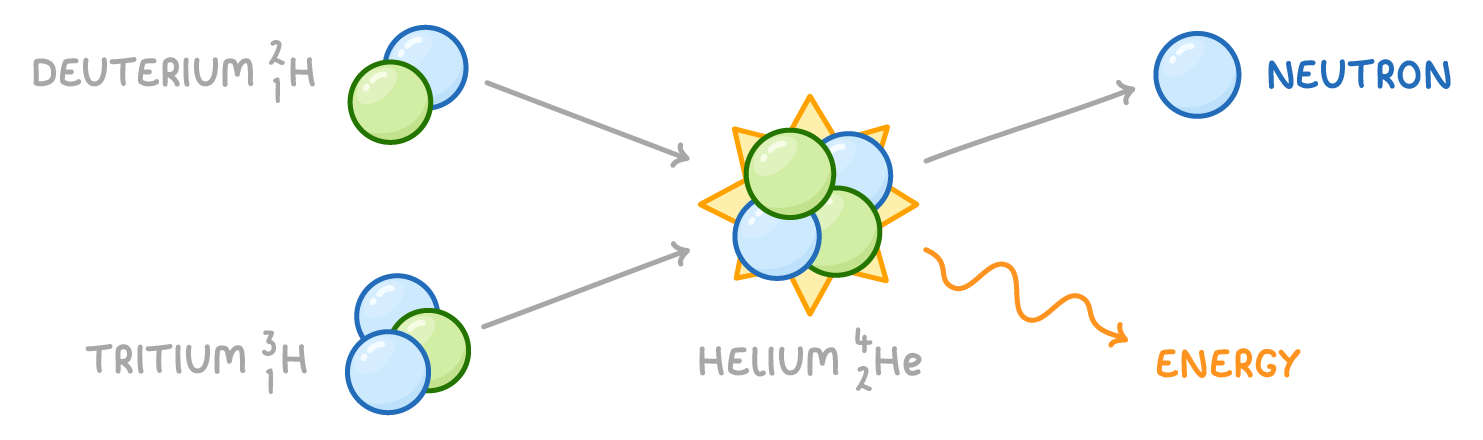
In a fusion reactor, two isotopes of hydrogen - deuterium (hydrogen-2) and tritium (hydrogen-3) - fuse to form helium and a neutron:
The nucleon numbers balance (2 + 3 = 4 + 1) and the proton numbers balance (1 + 1 = 2 + 0), so the equation conserves both mass number and charge.
Fusion is extremely hard to achieve
- Nuclei are positively charged, so they repel each other by electrostatic repulsion.
- To overcome this repulsion and fuse, nuclei must travel at very high speeds, which requires very high temperatures (around 10,000,000°C) and very high pressures.
The plasma problem
- At these temperatures, the fuel becomes a plasma (atoms stripped of their electrons).
- No container can withstand contact with plasma this hot, so strong magnetic fields are used to contain it away from the reactor walls.
Energy deficit
Creating and maintaining these extreme conditions currently takes more energy than the fusion releases, so no reactor generates usable electricity yet.
TermDefinition
Nuclear fusionThe joining of two light nuclei to form a heavier nucleus, releasing energy.
DeuteriumAn isotope of hydrogen with one proton and one neutron.
TritiumAn isotope of hydrogen with one proton and two neutrons.
PlasmaA state of matter where atoms have been stripped of their electrons, occurring at extremely high temperatures.