2.5 - Wind & Solar
Wind turbines generate electricity
- Wind turbines are built in exposed places where the wind is strong - moors, coasts, or out at sea.
- They can stand singly or be grouped into a wind farm.
How a wind turbine works
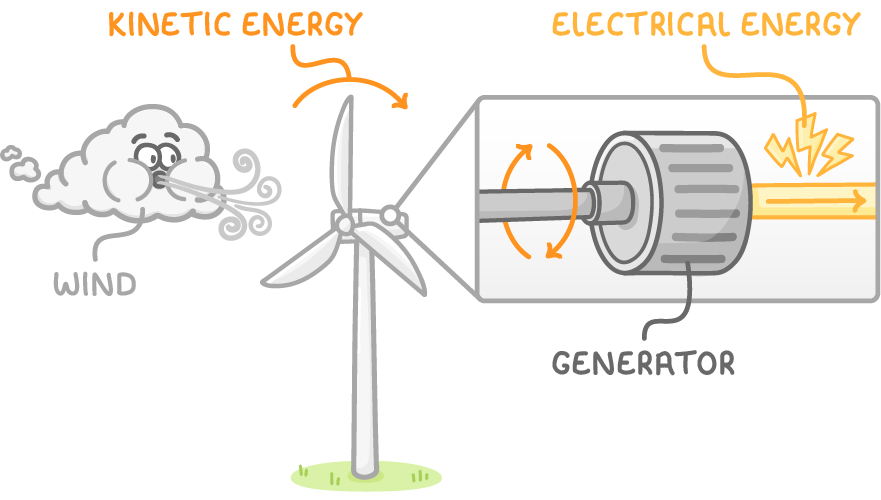
- Each turbine has a generator inside it.
- Moving air turns the blades, which turn the generator to produce electricity.
- The energy comes from the kinetic energy of the wind, so no fuel is burned.
Advantages
- No pollution while running (some is produced during manufacture).
- The wind is free, so there are no fuel costs and low running costs.
- Renewable - The wind won't run out.
- No permanent damage to the landscape.
Disadvantages
- High initial cost to build, especially out at sea.
- A very large number of turbines is needed to replace one conventional power station, taking up a lot of space and affecting views.
- Turbines can be noisy, annoying people living nearby.
- The supply is unreliable - they only work when it's windy, and output can't be increased to meet extra demand.
Solar cells generate electricity directly from sunlight
- Solar cells generate electricity directly from sunlight, with no moving parts and no burning of fuel.
- Individual cells join together to form solar panels, and multiple panels form a solar farm.
What they are used for
- Powering small, low-power devices such as calculators and watches.
- Providing electricity in remote places - satellites, road signs, and homes far from the mains grid.
- Small-scale generation on home rooftops.
Advantages
- No pollution while working.
- The Sun's energy is free and running costs are almost zero once installed.
- Renewable and very reliable in sunny countries.
Disadvantages
- High initial cost to manufacture and install.
- They only generate in the daytime, and the supply can't be increased to meet extra demand.
- They produce relatively little power for the area they take up.
Domestic wind and solar power can save and earn money
Households can install their own wind turbines or solar panels to generate electricity.
How it saves and earns money
- Lower bills - Generating electricity locally reduces the amount bought from the national grid.
- Feed-in Tariff (FIT) - Householders are paid for the renewable electricity they generate, including the electricity they use themselves.
- Export tariff - Any electricity the household doesn't use can be sold back to the national grid.
Weighing it up
- Wind turbines and solar panels have high initial costs and long payback times - the time it takes for savings and earnings to cover the original cost.
- Running and maintenance costs are low.
- The UK's variable weather means energy output fluctuates, which affects the savings made each year.
TermDefinition
Solar cellA device that generates electricity directly from sunlight.
Feed-in tariffA scheme where householders are paid for the renewable electricity they generate.
Export tariffA scheme where households can sell any electricity they do not use back to the national grid.
Payback timeThe time it takes for the money saved or earned by an installation, such as insulation or solar panels, to cover its original cost.