6.21 - Momentum & Force
Force as the rate of change of momentum
- A resultant force causes an object's momentum to change.
- The resultant force equals the rate of change of momentum.
Formula for force and change of momentum
Where:
- = Resultant force, in newtons (N)
- = Change in momentum, in kilogram metres per second (kg m/s)
- = Time taken for the change, in seconds (s)
For a given change in momentum, the longer the time taken, the smaller the force.
Worked example - Resultant force from a change in momentum
A car of mass 1,200 kg slows from 15 m/s to 10 m/s in 10 s. Calculate the resultant force on the car.

Step 1 - Find the change in momentum
Step 2 - Divide the change in momentum by the time taken
The resultant force on the car is 600 N. The minus sign shows that it acts against the car's motion, which is why the car slows down.
Vehicle safety features via work done over distance
- When a vehicle stops, work is done to transfer its kinetic energy to other stores.
- Since work done = force × distance, increasing the stopping distance reduces the force needed to stop the vehicle.
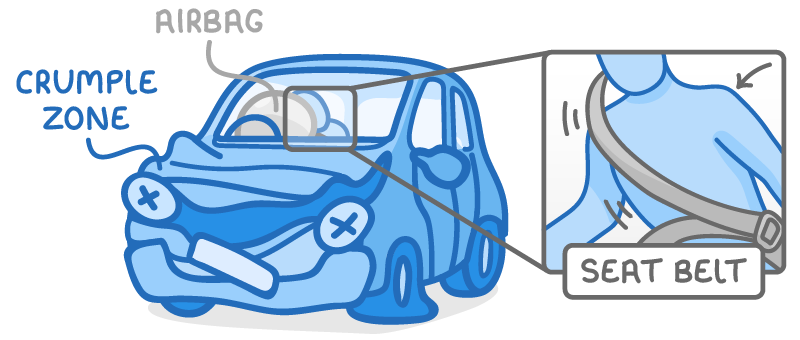
- Safety features increase the distance over which work is done to stop passengers, reducing the force on them and lowering the risk of injury.
Safety features that increase stopping distance
- Crumple zones - Areas at the front and back of the car that crumple easily, increasing the distance over which the car slows down and reducing the force.
- Seat belts - Stretch slightly when a large force acts on them, slowing passengers over a longer distance and reducing the force.
- Air bags - Compress as passengers hit them, increasing the distance over which they slow down and reducing the force.