19.5 - Electrolytic Cells
- 1
The structure and function of electrolytic cells
- 2
The electrolysis of molten salts
Electrolytic cells
An electrolytic cell is an electrochemical cell that uses electrical energy from an external source to drive a non-spontaneous redox reaction. This process is called electrolysis.
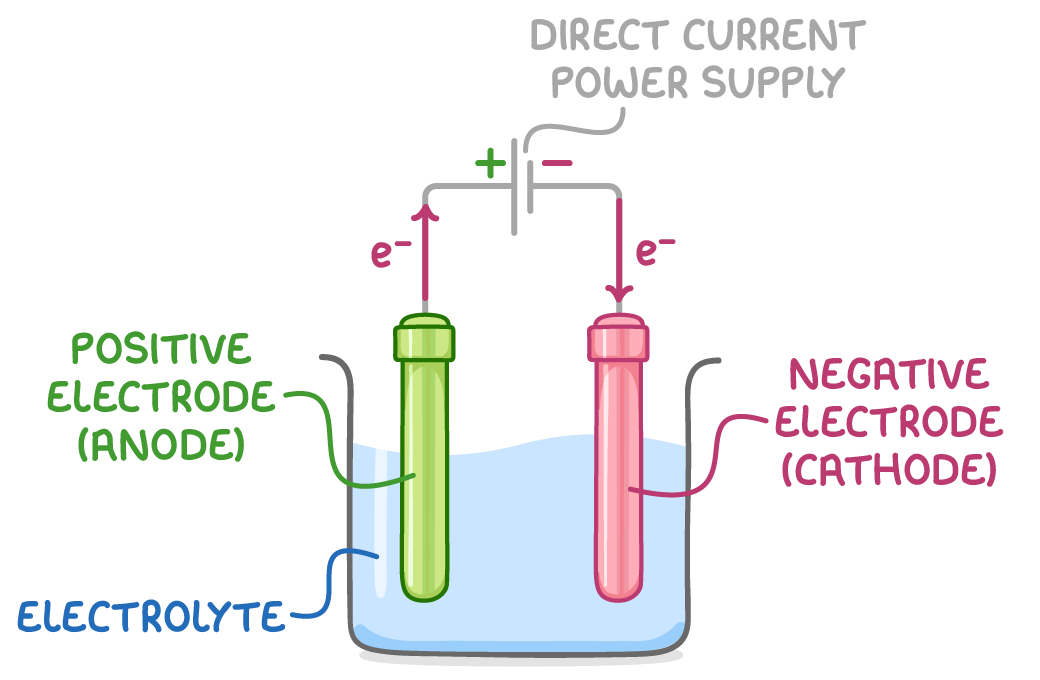
The key components of an electrolytic cell are:
- Electrolyte - A solution containing free-moving ions, either dissolved (aqueous solution) or molten ionic compound.
- Cathode - The negative electrode where reduction occurs and electrons enter the cell.
- Anode - The positive electrode where oxidation occurs and electrons leave the cell.
- DC power source - Provides the electrical energy to drive the non-spontaneous redox reaction.
In the closed circuit, electrons flow from the negative terminal of the power source to the cathode, where cations are reduced. The electrons then flow through the electrolyte to the anode, where anions are oxidised. Finally, the electrons return to the positive terminal of the power source.
Electrolysis of molten salts
When a molten ionic compound undergoes electrolysis, the cations (usually metals) are reduced at the cathode to form the pure metal, while the anions are oxidised at the anode. The identity of the products depends on the composition of the molten salt.
For example, in the electrolysis of molten sodium chloride (NaCl):
Sodium ions are reduced at the cathode to form liquid sodium: Na^+^ + e- ➔ Na
Chloride ions are oxidised at the anode to form chlorine gas: 2Cl^-^ ➔ Cl_2_ + 2e^-^
The overall equation is: 2NaCl_(l)_ ➔ 2Na_(l)_ + Cl_2(g)_
This process is used industrially to produce reactive metals like sodium, magnesium, and aluminium from their molten salts. An inert atmosphere is used to prevent the oxidation of the metal product.
Worked example 1 - Electrolysis of molten Al_2_O_3_
Deduce the products of the electrolysis of molten aluminium oxide, Al_2_O_3(l)_, with inert electrodes. Write the overall cell equation and the half-equations occurring at each electrode.
Step 1: Split the electrolyte into ions
Al2O3(l) ➔ 2Al3+ + 3O2-
Step 2: Predict direction of ion migration
Al3+ ions will migrate towards the cathode.
O2- ions will migrate towards the anode.
Step 3: Reaction at cathode
Al^3+^ ions will be reduced to liquid aluminium at the cathode.
Al3+ + 3e- ➔ Al
Step 4: Reaction at anode
O^2-^ ions will be oxidised to oxygen gas at the anode.
O2- ➔ 1⁄2O2 + 2e-
Step 5: Overall equation
Ionic: 2Al3+ + 3O2-➔ 2Al + 3⁄2O2
Full: Al2O3(l) ➔ 2Al_(l)_ + 3⁄2O2(g)