2.15 - Government Response to Externalities
Negative production externalities and interventions
Negative externalities of production occur when the creation of goods or services generates unwanted side effects that harm third parties not involved in the transaction. These external costs are not reflected in the market price, leading to overproduction beyond the socially optimal level. Governments can intervene using various tools to correct this market failure by making firms account for these costs.
Tools for addressing negative production externalities
- Indirect taxes (Pigovian taxes):
- These are levies placed on producers to match the external costs they create, based on the polluter pays principle.
- Such taxes increase a firm's marginal private costs (MPC) to align with marginal social costs (MSC), encouraging reduced output to a more efficient level.
- Part of the tax burden often shifts to consumers via higher prices.
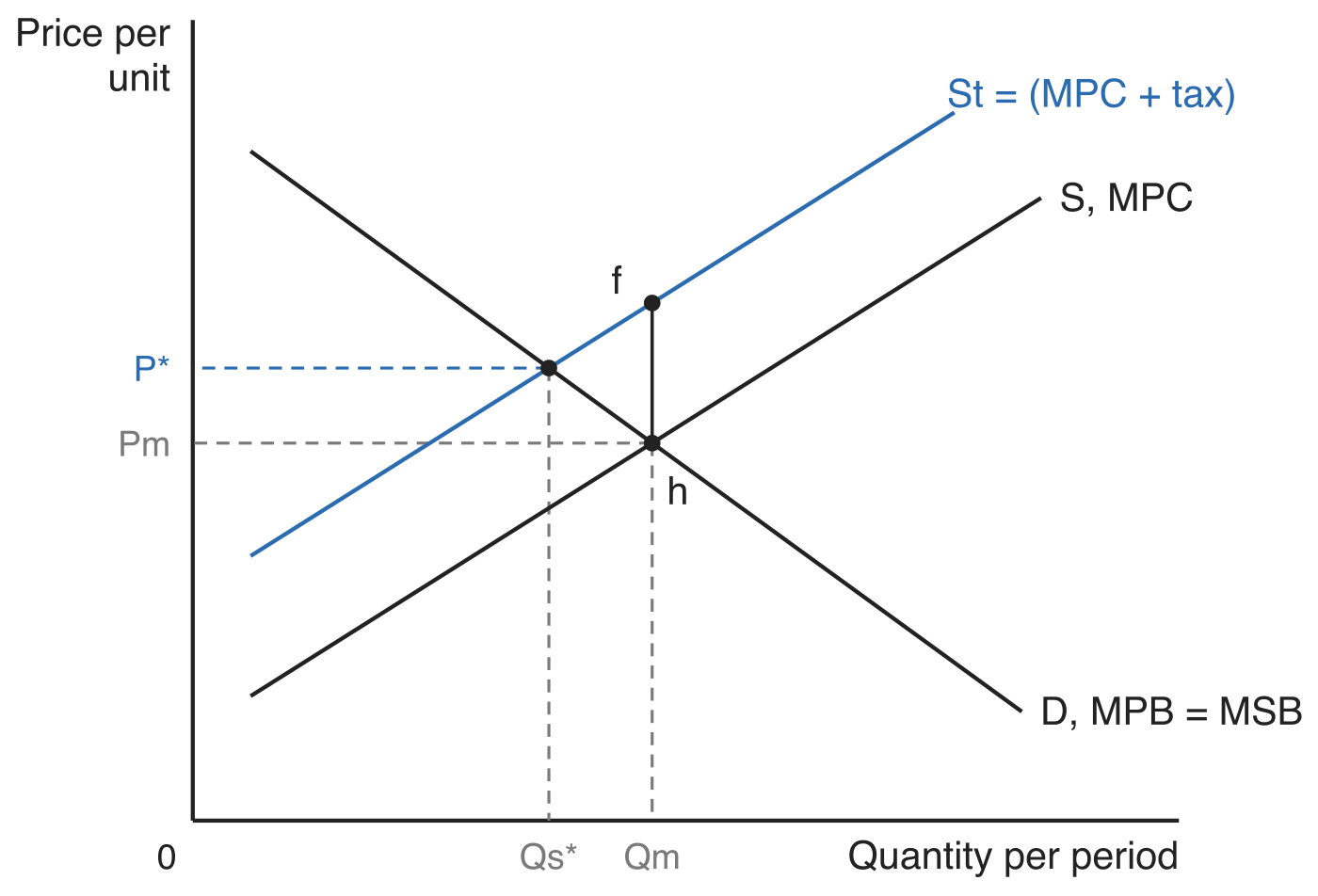
The diagram below shows a Pigovian tax in the market for steel. Before the tax, the market settles where the private supply curve S, MPC meets demand D, MPB = MSB, at point h with price Pm and quantity Qm. The government estimates the pollution costs firms create and sets the tax equal to them: that is the vertical distance fh, measured between point f on the new supply curve and point h below it. Steel producers now pay the tax on top of their manufacturing costs, so supply shifts up to St = (MPC + tax), which sits at the level of marginal social cost. The market moves to the higher price P* and the lower quantity Qs*, the socially optimal level of output, where marginal social benefit equals marginal social cost. Even though the tax is levied on producers, part of it reaches buyers as the price rises from Pm to P*, and that is what cuts their purchases from Qm to Qs*.
- Carbon taxes:
- A specific type of Pigovian tax applied to fossil fuels based on their CO2 emissions during manufacturing and usage.
- These taxes motivate firms and individuals to conserve energy or adopt cleaner alternatives.
- Revenue from these taxes can be redistributed through rebates or used to lower other taxes.
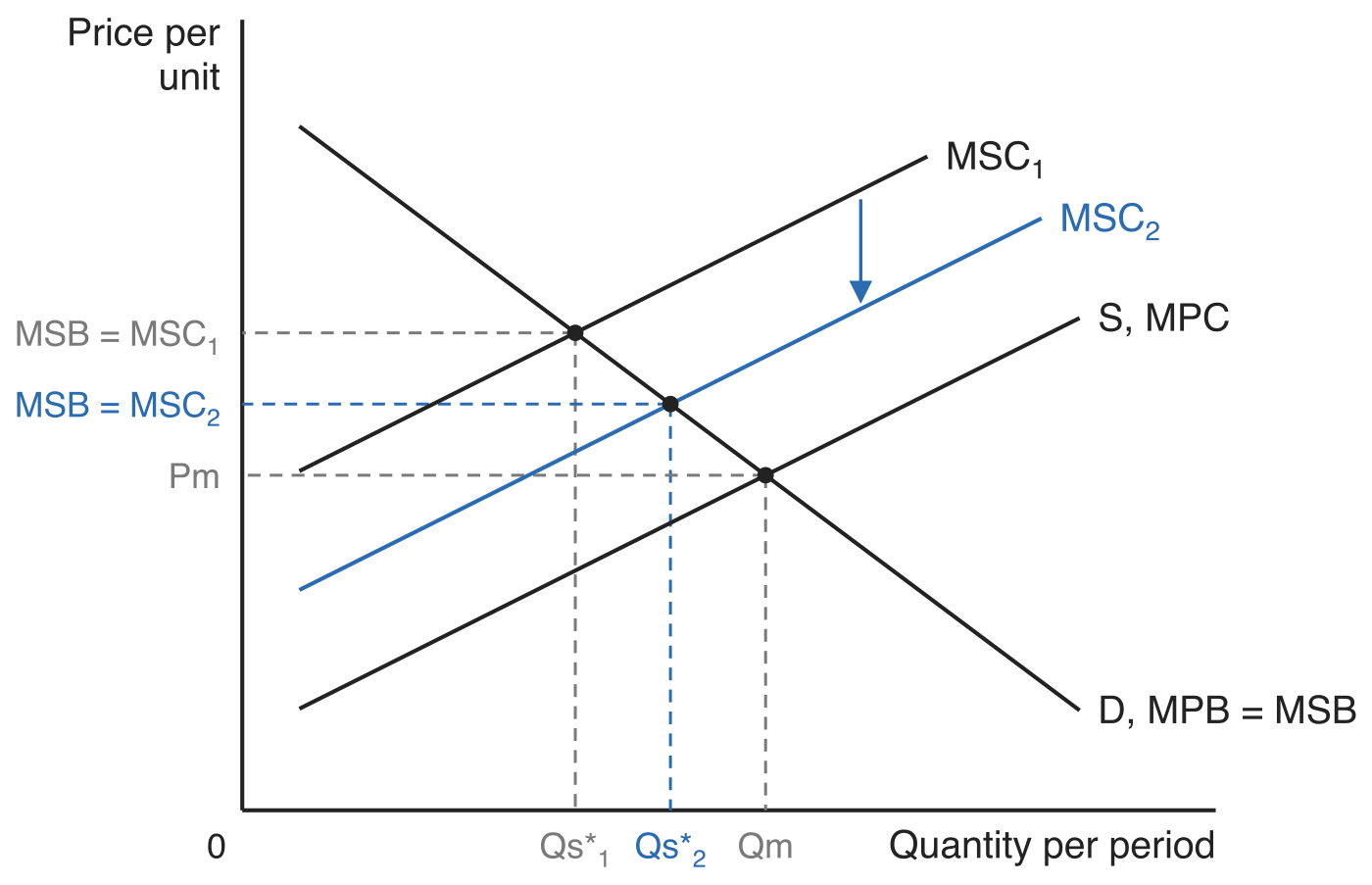
The diagram below shows a carbon tax in the market for electricity. Lower use of carbon-based fuels reduces the external costs of production, so the marginal social cost curve shifts down from MSC1 to MSC2 while the private supply curve S, MPC and demand D, MPB = MSB stay where they are. The socially optimal level of output rises from Qs1, where MSB = MSC1, to Qs2, where MSB = MSC2, moving closer to the market outcome of Qm at price Pm. The vertical gap between S, MPC and MSC2 is smaller than the gap up to MSC1, so the carbon tax needed on the cleaner, lower-carbon fuel is smaller too.
- Tradable pollution permits:
- Under this cap-and-trade approach, authorities establish overall emission limits and distribute permits that firms can buy and sell.
- Companies with lower costs to cut emissions reduce pollution and sell excess permits, while those with higher costs purchase them.
- Direct regulation - This involves setting strict rules on production limits, required technology standards, or operational locations to control pollution directly.
Comparing intervention methods from a policymaker's viewpoint
Regulations or tradable permits are often favoured when precise control over pollution quantities is essential, while taxes may be preferred for stimulating innovation in cleaner technologies.
Negative consumption externalities and interventions
Negative externalities of consumption arise when using certain goods, known as demerit goods, creates harmful impacts on uninvolved third parties. This leads to overconsumption in the market. Governments use targeted measures to raise prices or influence behaviour, aiming to lower demand to a socially efficient point.
Strategies to tackle negative consumption externalities
- Taxes on demerit goods:
- Levies on items like cigarettes or high-sugar beverages increase their cost, discouraging excessive use.
- However, with products like alcohol, consumers might switch to lower-priced options, creating a chain of substitutions that undermines the tax's effectiveness.
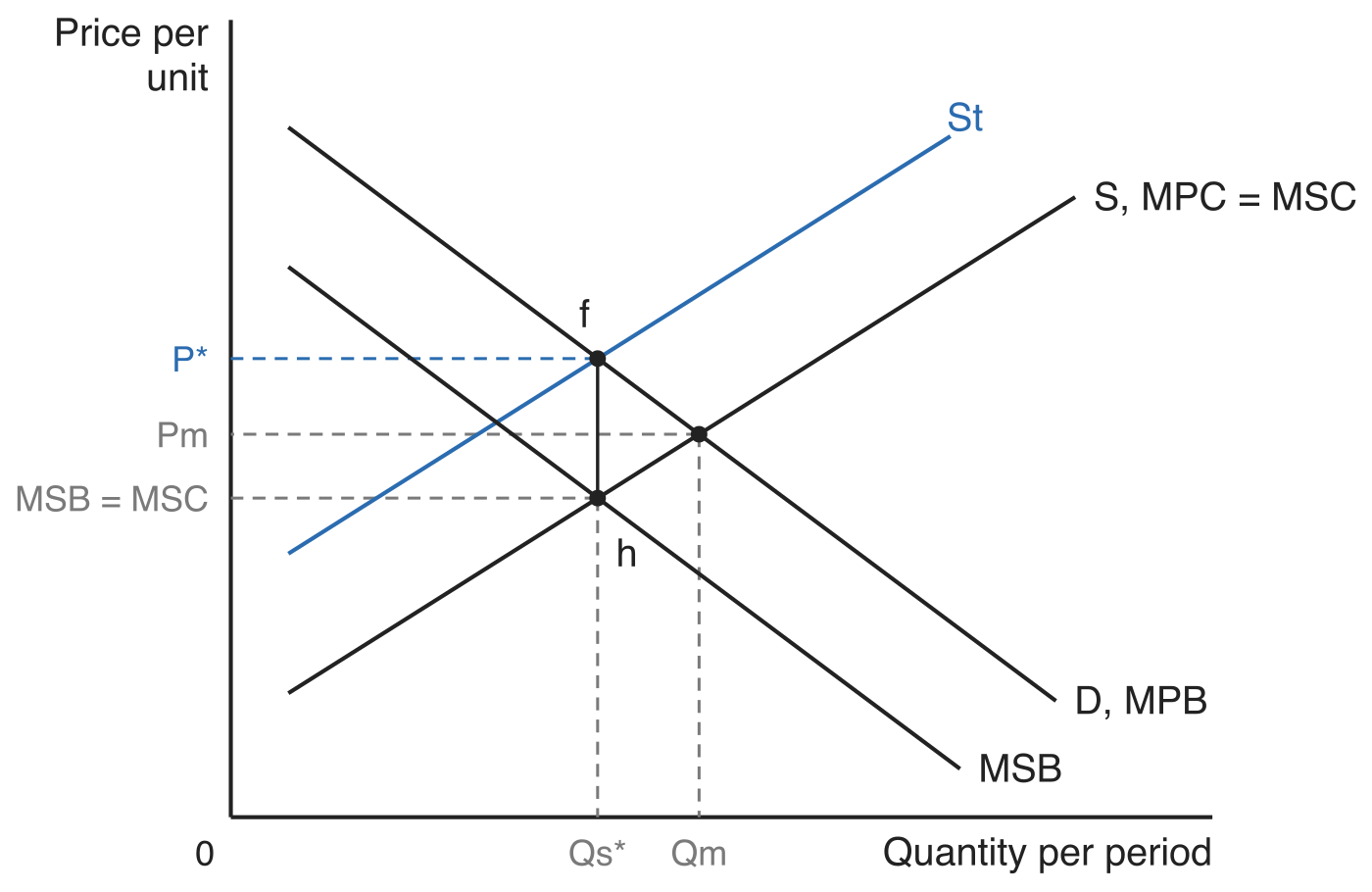
The diagram below shows an indirect tax in the market for sugary beverages. Because consumption imposes costs on third parties, the marginal social benefit curve MSB lies below the private demand curve D, MPB. Left alone, the market settles where D, MPB meets supply S, MPC = MSC, at price Pm and quantity Qm, which is above the socially optimal quantity Qs*. A specific tax equal to the vertical distance fh shifts supply up to St, so the price rises to P* at point f and consumption falls to Qs*, the socially optimal level. Point h, directly below f, is where MSB meets S, MPC = MSC, and the height there is the level at which MSB = MSC.
- Minimum unit pricing - Establishing a base price for goods such as alcohol prevents cheap alternatives and ensures consumption falls without easy substitutions.
- Plain packaging requirements - Mandating uniform, unbranded packaging for products like tobacco reduces their attractiveness and perceived appeal.
- Nudges - Gentle prompts that guide choices without limiting freedom, such as strategic messaging or default settings that promote better decisions.
- Public awareness campaigns - Educational efforts that inform people about risks, supporting other measures to change consumption patterns.
Positive production externalities and interventions
Positive externalities of production happen when manufacturing activities create beneficial effects for third parties, such as knowledge spillovers or environmental improvements. These lead to underproduction in the free market, as firms do not capture all the benefits. Government actions aim to boost output to the socially optimal level by supporting producers.
Approaches to encourage positive production externalities
- Subsidies - Financial support provided to firms that generate external benefits, lowering their costs and increasing production. The value of subsidies should ideally match the external benefits to achieve efficiency.
- Direct provision - Governments may supply goods or services directly, especially for infrastructure or research and development, where positive spillovers are substantial.
When implementing subsidies or direct provision, the opportunity costs, such as funds diverted from other public services, must be weighed against the societal gains.
Positive consumption externalities and interventions
Positive externalities of consumption occur when using merit goods, like education or vaccinations, benefits third parties beyond the direct user. This results in underconsumption without intervention. Governments promote these goods to maximise social welfare, often considering both external benefits and access issues for lower-income groups.
Methods to promote positive consumption externalities
- Subsidies for merit goods - Reducing the price to encourage greater use, such as subsidising healthy foods or public transport.
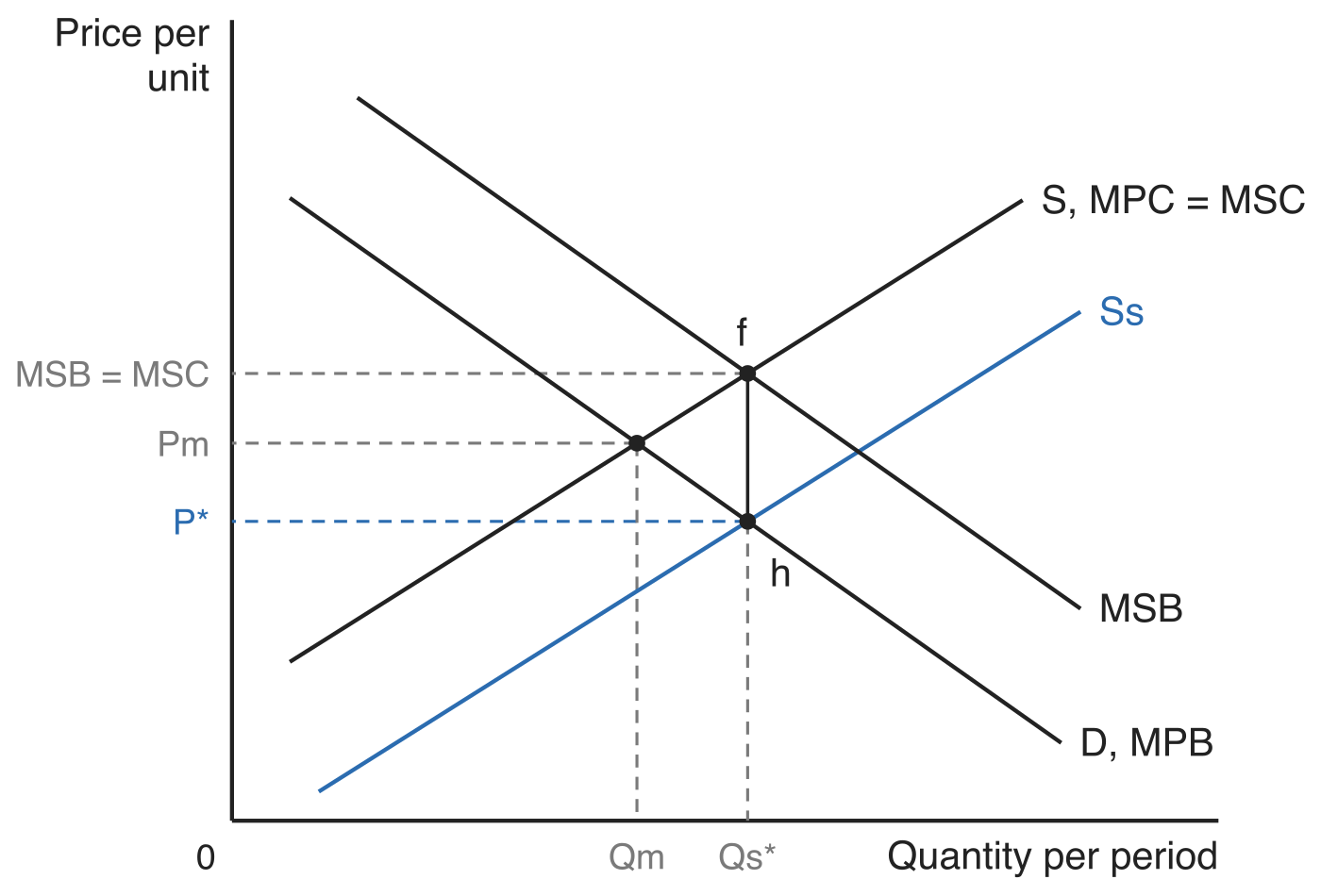
The diagram below shows a subsidy in the market for flu vaccinations. Because vaccination protects other people as well as the person vaccinated, the marginal social benefit curve MSB lies above private demand D, MPB. Left alone, the market settles where D, MPB meets S, MPC = MSC, at price Pm and quantity Qm, below the socially optimal quantity Qs* marked by point f, where MSB = MSC. A subsidy equal to the vertical distance fh lowers production costs and shifts supply out to Ss, so the price consumers pay falls to P* at point h and consumption rises to Qs*.
- Legislation - Enforcing consumption through laws, like compulsory schooling or required immunisations.
- Direct provision - Supplying merit goods at no or low cost, as seen in state-funded education and healthcare systems.
- Public awareness campaigns - Initiatives to highlight benefits and encourage uptake, complementing other policies.
As with production subsidies, the opportunity costs of these interventions need careful evaluation against their broader social advantages.
Which tools fit which externality
| Type of externality | Government tools |
|---|---|
| Negative production | Indirect (Pigovian) taxes, carbon taxes, tradable pollution permits, direct regulation |
| Negative consumption | Taxes on demerit goods, minimum unit pricing, plain packaging requirements, nudges, public awareness campaigns |
| Positive production | Subsidies, direct provision |
| Positive consumption | Subsidies for merit goods, legislation, direct provision, public awareness campaigns |