2.12 - Indirect Taxes & Subsidies
The role of governments in microeconomics
Governments step in to influence market outcomes for various reasons, aiming to address imbalances and promote broader societal goals.
Reasons for government intervention in markets
- Supporting producers - Assistance is frequently provided to sectors like agriculture.
- Aiding low-income groups - Policies help make essential items more accessible to those with limited financial resources.
- Adjusting production and consumption - Governments seek to alter levels of output or usage.
- Addressing market failures - Intervention corrects situations where markets do not allocate resources efficiently.
- Promoting fairness - Efforts are made to reduce inequalities.
Indirect taxation and its effects
Indirect taxes are levied on spending rather than income, affecting the price of goods and services. They can be fixed amounts per item (specific taxes) or percentages of the price (ad valorem taxes).
Purposes of indirect taxes
- Generating funds - These taxes provide income for public services and government projects.
- Reducing harmful consumption - They discourage the use of demerit goods that negatively affect individuals and society.
- Environmental protection - Taxes on activities such as carbon emissions help cut down on pollution and reliance on non-renewable energy sources.
- Shielding local businesses - Higher taxes on imported goods can make domestic products more competitive.
Market effects of indirect taxes
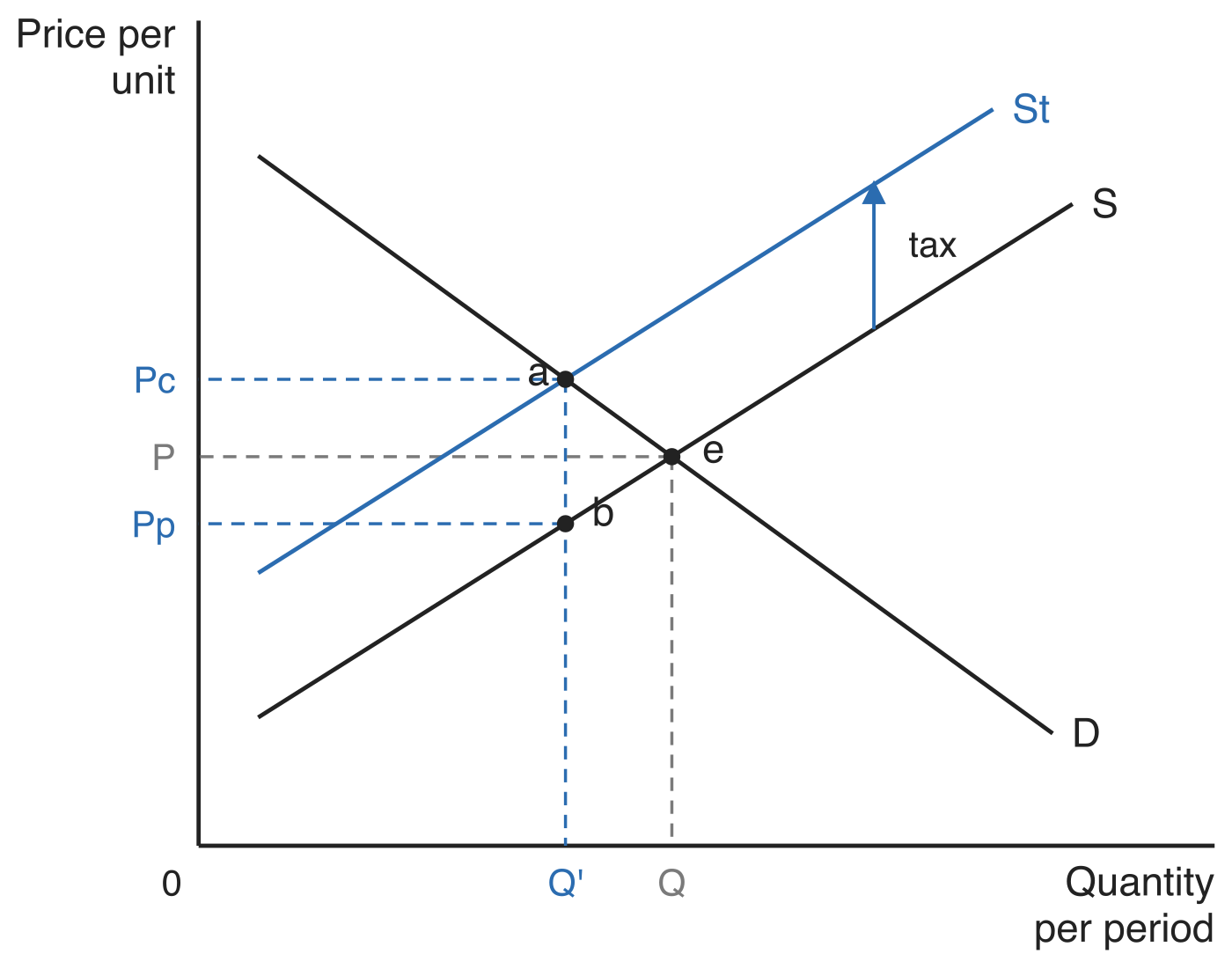
An indirect tax is an extra cost of production, so it shifts the supply curve upwards by the value of the tax, from S to St. For a specific tax that shift is parallel to the original supply curve; for an ad valorem tax St is steeper than S, because a percentage of a higher price is a larger amount of money. The analysis that follows is the same either way.
The diagram below shows a specific tax. Before the tax the market is in equilibrium at point e, where demand D meets supply S, with price P and quantity Q. Once supply has shifted to St the new equilibrium is at point a: the price buyers pay rises to Pc and the quantity traded falls to Q'. Firms are left with only Pp per unit, the price consumers pay minus the tax, so the vertical gap ab at Q' is the tax per unit.
Tax incidence
Tax incidence shows how the burden of a tax is shared between buyers and sellers, depending on the price elasticities of demand and supply.
Where:
- PES = Price elasticity of supply
- PED = Price elasticity of demand
Where:
- PED = Price elasticity of demand
- PES = Price elasticity of supply
The more inelastic the demand or elastic the supply, the greater the share borne by consumers.
Worked example - Calculating tax incidence
A government imposes a tax on a good where the price elasticity of demand (PED) is 0.7 and the price elasticity of supply (PES) is 1.3. Determine the proportion of the tax paid by consumers and producers.
Step 1: Identify the values
- PED = 0.7
- PES = 1.3
Step 2: Apply the formula for consumers' share
Step 3: Apply the formula for producers' share
Step 4: Interpretation
Consumers bear approximately 65% of the tax burden, while producers bear 35%, due to the relatively elastic supply.
Impacts of indirect taxes on stakeholders
- Consumers - Face increased prices, leading to lower quantities bought and a reduction in consumer surplus; this can hit low-income groups hardest as the tax takes a larger share of their earnings.
- Producers - Receive less revenue per unit after tax, with fewer sales and diminished producer surplus.
- Government - Gains revenue to fund services.
- Society - Suffers a deadweight loss from reduced market efficiency, but benefits if the tax targets negative externalities like pollution; however, these taxes are regressive, disproportionately affecting poorer people.
Subsidies and their impacts
Subsidies are financial contributions from the government to businesses that lower their costs, encouraging greater output and lower prices.
Purposes of subsidies
- Boosting producer incomes - They help sectors like farming.
- Improving affordability - Essential items become cheaper for those on lower incomes.
- Encouraging key sectors - Support is given to areas like green energy.
- Promoting merit goods - Increased access to beneficial services such as schooling or medical care.
- Enhancing trade position - Domestic firms gain protection from foreign competition or improved ability to export.
Market effects of subsidies
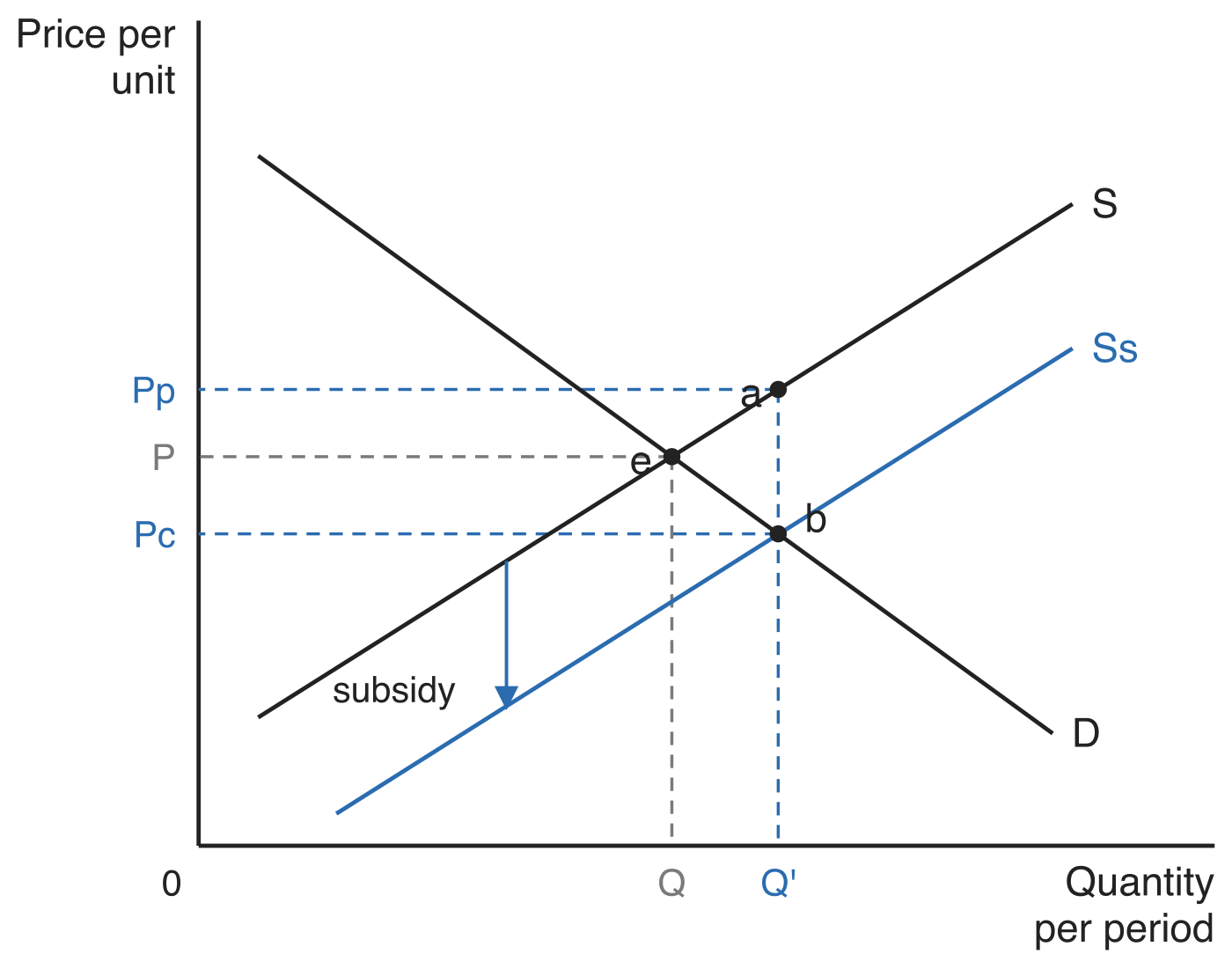
A subsidy reduces firms' production costs, so it shifts the supply curve downwards by the amount of the subsidy, from S to Ss, parallel to the original curve.
The diagram below shows the result. Before the subsidy the market is in equilibrium at point e, where demand D meets supply S, with price P and quantity Q. With supply at Ss the new equilibrium is at point b: the price consumers pay falls to Pc and the quantity produced and consumed rises to Q'. Producers now receive Pp per unit, the price buyers pay plus the subsidy, so the vertical gap ab at Q' is the subsidy per unit.
Impacts of subsidies on stakeholders
- Consumers - Enjoy reduced prices, leading to higher consumption and greater consumer surplus.
- Producers - Gain more revenue per unit, with increased sales and producer surplus.
- Government - Incurs costs funded by taxes, loans, or reduced spending elsewhere.
- Society - Faces a deadweight loss from market distortion, but gains if subsidies support positive externalities like clean technology.
Policy considerations for taxes and subsidies
When implementing indirect taxes or subsidies, governments must balance various factors to ensure effective outcomes. These tools have advantages but also potential drawbacks that need careful evaluation.
Key policy factors
| Policy aspect | Advantages | Disadvantages |
|---|---|---|
| Ease of implementation | Indirect taxes are simple to collect | They disproportionately burden the poor |
| Political and social issues | Subsidies are often popular with voters | High taxes on addictive items may create illegal markets; subsidies can be influenced by lobby groups |
| Environmental and global effects | Taxes can reduce pollution | Subsidies in areas like fishing may harm global resources; public opposition to green taxes |
| Overall evaluation | Policies should compare total societal benefits with costs | National gains might cause international problems |
Decisions require weighing benefits like revenue or affordability against issues such as inequality or market distortions.