4.1 - Benefits of Trade
International trade, exports, and imports
International trade involves the exchange of goods and services between countries. This exchange has grown significantly over time, with world trade rising from around 27% of global gross domestic product (GDP) in 1970 to approximately 60% in 2018.
Key terms in international trade
- International trade - The purchase and sale of goods and services across national borders.
- Exports (X) - Goods and services produced domestically and sold to buyers in other countries.
- Imports (M) - Goods and services produced abroad and purchased by domestic consumers or firms.
Benefits of free trade
Free trade occurs when countries exchange goods and services without barriers such as tariffs or quotas. It brings numerous advantages by promoting efficiency, competition, and growth across economies.
Specialisation and resource allocation
- Specialisation - Countries can focus on producing goods and services where they have a comparative advantage, leading to higher overall output and consumption levels.
- Expanded consumption possibilities - Through trade, nations can consume beyond their own production possibilities curve (PPC) by importing items they produce less efficiently.
- Improved resource allocation - Scarce resources are used more effectively both domestically and globally.
Competition and efficiency
- Reduction in monopoly power - Domestic firms face competition from imports, preventing them from dominating markets and charging excessive prices.
- Lower prices and better quality - Increased competition drives down consumer prices and encourages firms to improve product standards.
- Greater efficiency - Firms must optimise resource use and minimise costs to remain competitive.
- Incentives for innovation - Businesses innovate to compete with imports or to enter overseas markets.
Growth and variety
- Economies of scale - Firms can expand production for larger international markets, lowering average costs, which is particularly beneficial for companies in smaller countries.
- Access to specialised imports - Businesses can import tailored capital goods, such as machinery or equipment, enhancing productivity and profits.
- Increased consumer choice - Trade provides a wider range of goods and services for consumers.
- Technology and resource diffusion - Trade facilitates the spread of technology embedded in imported goods and allows countries to acquire natural resources they lack domestically.
- Driver of economic growth - Overall, trade boosts growth through specialisation, competition, technology transfer, economies of scale, and rising export revenues.
Welfare effects of free trade
Free trade affects social welfare by altering prices, surpluses, and resource distribution. While it generally creates net gains, it produces winners and losers within an economy.
Welfare in a closed economy (autarky)
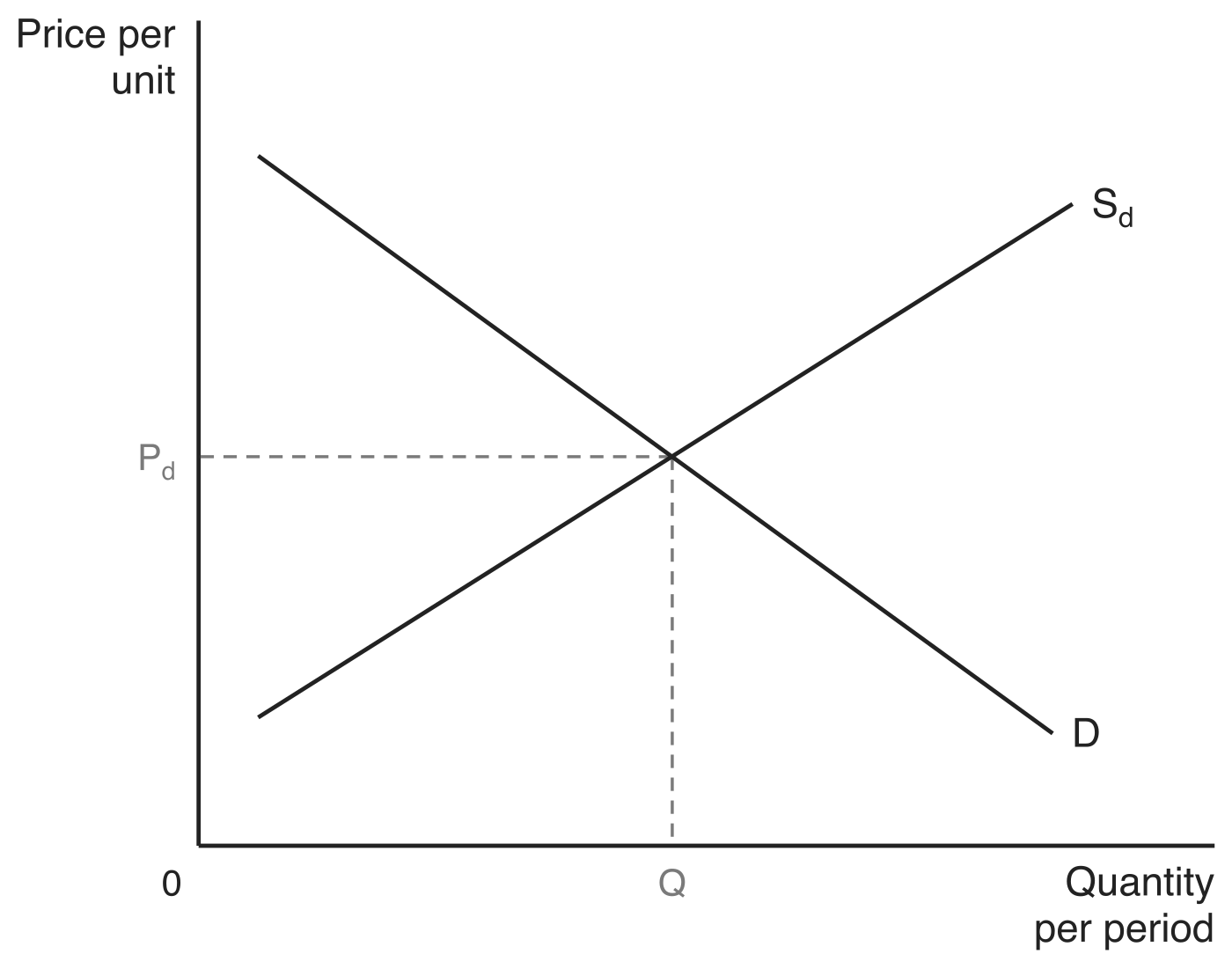
In autarky, an economy does not trade internationally, so domestic demand and supply alone set the equilibrium price and quantity. In the diagram below, the domestic supply curve Sd crosses the domestic demand curve D at the domestic price Pd per unit, with Q units traded per period.
Export scenario (world price exceeds domestic price)
At the world price Pw, domestic producers can sell as much as they like without moving it, so world supply is the horizontal line Sw, drawn above the autarky price Pd where Sd crosses D. Consumers cut back to Q1, where the world price meets D, while domestic producers expand to Q2 on Sd, so the difference Q1Q2 is exported. The diagram below shows this, with areas A, B and C measuring the welfare changes.
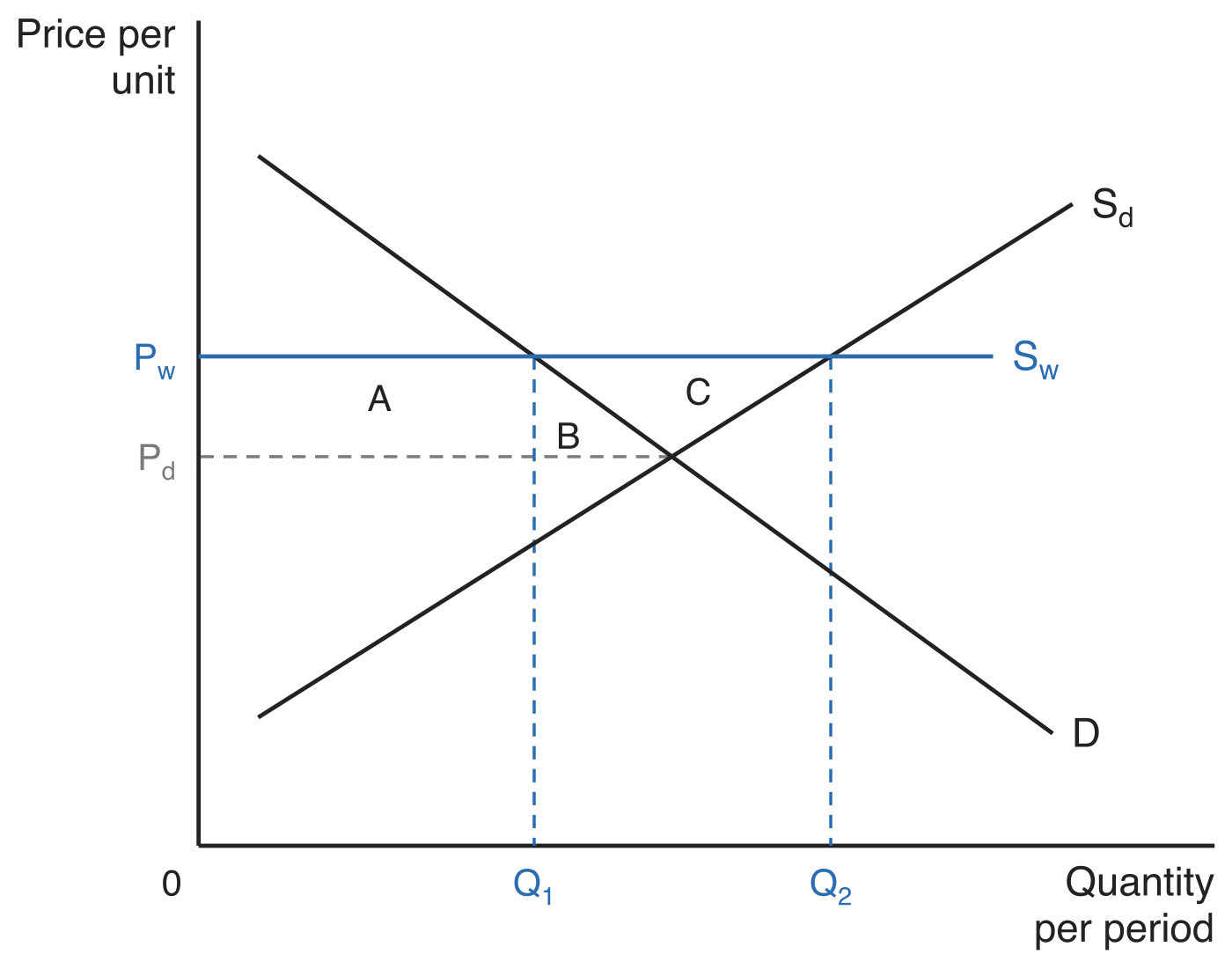
When the global price is higher than the domestic price, the country becomes an exporter:
- Consumer surplus - Decreases by areas A and B, since consumers now pay Pw instead of Pd and buy less
- Producer surplus - Increases by a larger amount, areas A, B and C together, since producers receive Pw on a larger quantity
- Net welfare effect - Overall gain in welfare equal to area C. In theory, producers could compensate consumers (e.g., through transfers) and still be better off.
Import scenario (world price is below domestic price)
At the world price Pw, domestic consumers can buy as much as they like without moving it, so world supply is the horizontal line Sw, drawn below the autarky price Pd where Sd crosses D. Domestic producers cut back to Q3 on Sd while consumers expand to Q4 on D, so the difference Q3Q4 is imported. The diagram below shows this, with areas A and B measuring the welfare changes.
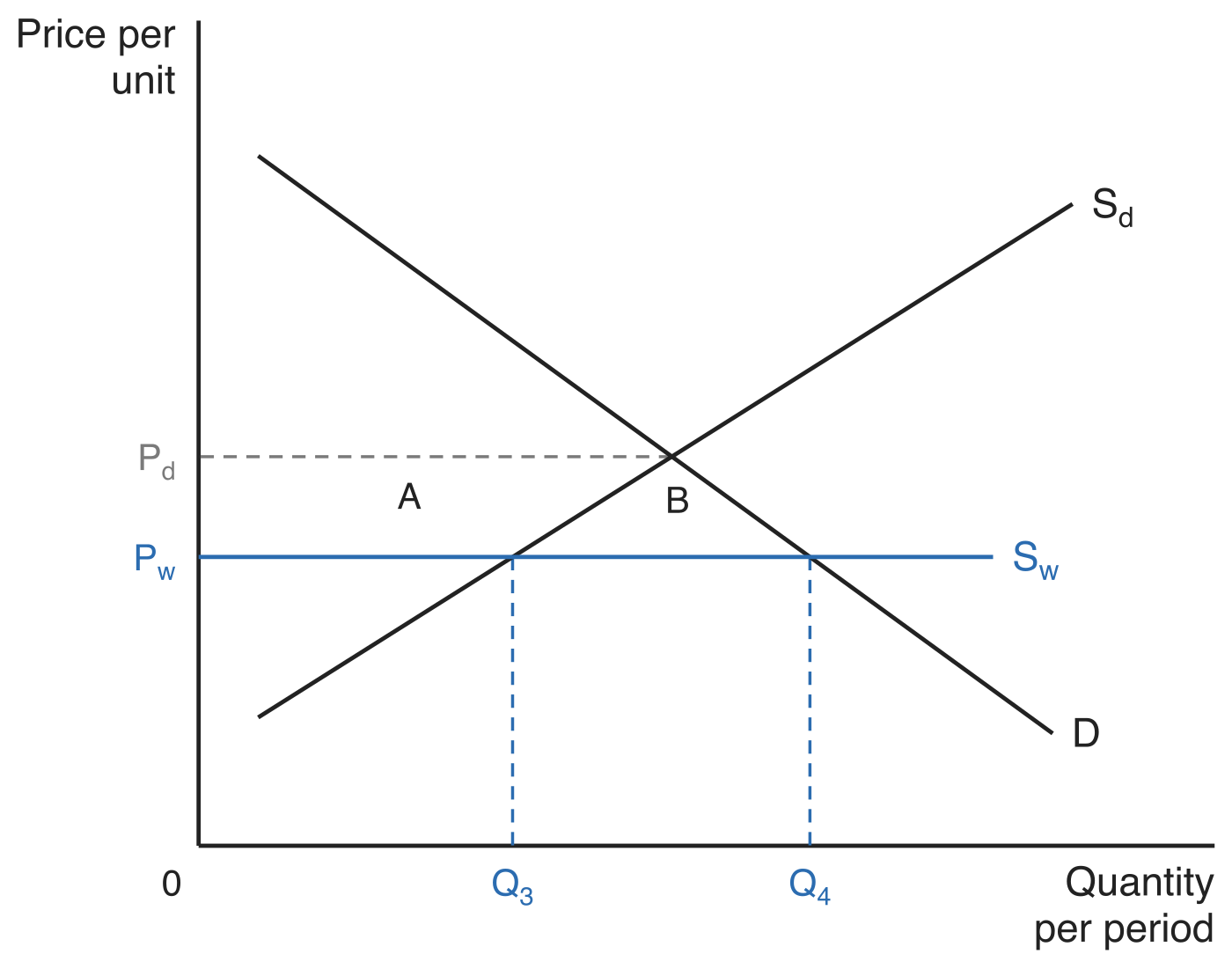
When the global price is lower than the domestic price, the country becomes an importer:
- Consumer surplus - Increases by areas A and B, since consumers now pay Pw instead of Pd and buy more
- Producer surplus - Decreases by a smaller amount, area A alone, since producers receive Pw on a smaller quantity
- Net welfare effect - Overall gain in welfare equal to area B. Theoretically, consumers could compensate affected producers while remaining better off.
Free trade thus enhances total social welfare but creates winners and losers within the economy.
The concept of a small country
A small country in the context of international trade is one that can buy or sell as much of a product as it wants without affecting the world price.