1.4 - Modelling the Economy
The basic circular flow model
The circular flow model provides a simplified view of how key parts of an economy interact. It focuses on the main decision-makers: households, firms, the government, and the foreign sector.
Key interactions in the basic model
In its simplest form, the model includes only households and firms:
- Households supply factors of production to firms and receive income in return.
- Firms use these factors to produce goods and services, which they sell to households in exchange for spending.
Types of flows in the model
- Real flows - These involve the physical movement of resources: factors of production from households to firms, and goods and services from firms to households.
- Monetary flows - These involve the exchange of money: income (factor payments) from firms to households, and spending on goods and services from households back to firms.
The diagram below shows both kinds of flow together. The inner solid arrows are the real flows and the outer dashed arrows are the monetary flows, so every real flow is matched by a payment travelling in the opposite direction.
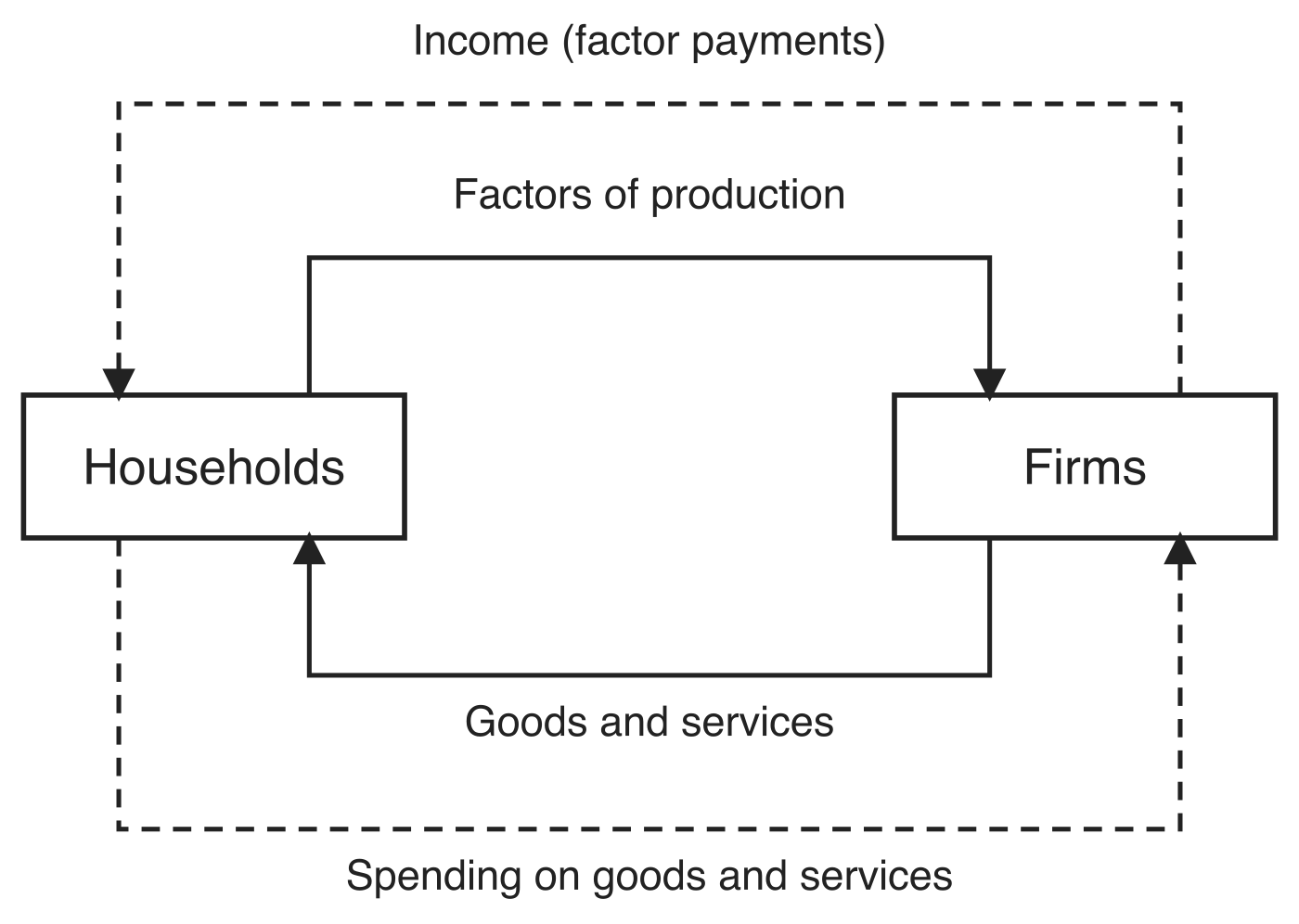
In this basic setup, all income is assumed to be spent immediately, so monetary flows balance out. National income represents the total value of all payments made to households for their factors of production.
Factors of production and factor payments
Factors of production are the essential resources used by firms to create goods and services. Households own these factors and provide them to firms, receiving payments in return.
The four factors and their factor payments
Each factor receives a specific type of payment:
| Factor of production | What it is | Factor payment |
|---|---|---|
| Land | Natural resources | Rent |
| Labour | The workforce | Wages |
| Capital | Man-made items such as machinery, tools, or buildings | Interest |
| Entrepreneurship | The skills and risk-taking involved in organising the other factors to start and run businesses | Profits |
National income is calculated as the total of all these payments across the economy.
Leakages and injections in the circular flow model
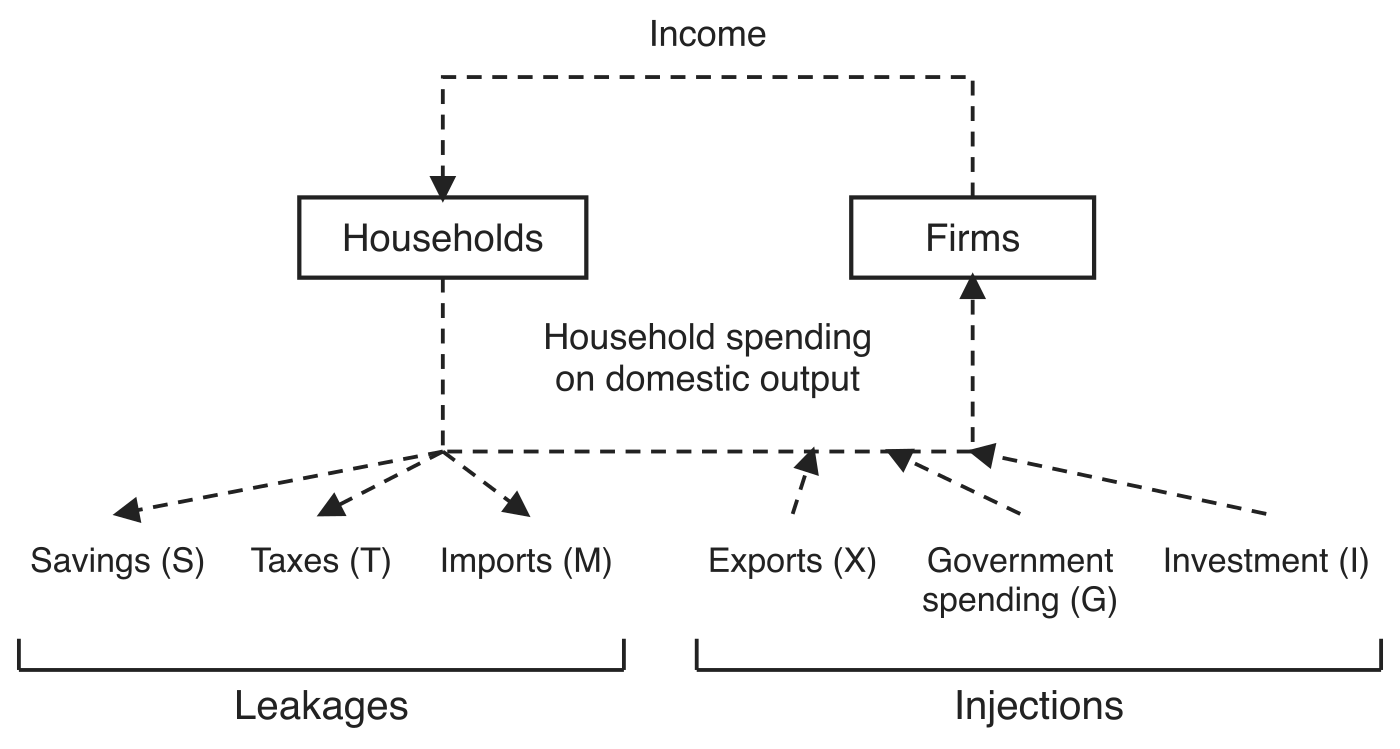
As the model becomes more realistic, it includes ways that money leaves or enters the flow of income and spending. Leakages remove money from the circular flow, while injections add money back in. Financial institutions, like banks, help channel savings into investments.
Leakages from the circular flow
Leakages occur when income is not spent on domestic goods and services, reducing the money circulating in the economy:
- Savings (S) - Money set aside by households.
- Taxes (T) - Payments to the government.
- Imports (M) - Spending on goods and services from abroad.
Injections into the circular flow
Injections add spending on domestic goods and services from sources other than household consumption:
- Investment (I) - Spending by firms on new capital.
- Government spending (G) - Expenditure by the government.
- Exports (X) - Income from selling domestic goods and services to foreign buyers.
The diagram below adds these flows to the basic model. Income still travels from firms to households and household spending on domestic output still travels back from households to firms, but the leakages now drain away from that spending flow before it reaches firms, and the injections join it from outside.
Equilibrium conditions in the circular flow model
Equilibrium in the circular flow occurs when the total injections equal the total leakages, keeping national income stable.
Equilibrium in different economic scenarios
- Closed economy without government - Equilibrium requires I = S.
- Closed economy with government - Equilibrium requires I + G = S + T.
- Open economy with government and foreign sector - Equilibrium requires I + G + X = S + T + M.
These conditions ensure that money entering the flow matches money leaving it, maintaining balance.
Economic implications of leakages and injections
The balance between leakages and injections directly affects the level of national income and economic activity.
Effects on national income
- Injections equal leakages - National income stays constant.
- Injections greater than leakages - National income tends to increase.
- Injections less than leakages - National income tends to decrease.