4.10 - Exchange Rates
Definition and reciprocal nature of exchange rates
An exchange rate represents the value of one currency in terms of another, essentially showing how much of a foreign currency can be obtained for a unit of the domestic currency.
Key features of exchange rates
- Reciprocal relationship - If the exchange rate of currency A against currency B is e (e.g., £1 = €1.35), then the exchange rate of currency B against currency A is 1/e (e.g., €1 = £0.74).
- Dual role in transactions - When someone buys one currency, they are at the same time selling another currency.
- Demand and supply linkage - In a demand and supply diagram for currencies, the demand for the currency being purchased also represents the supply of the currency being sold.
Different exchange rate systems
Exchange rate systems determine how currency values are set and managed. There are three main types, each with distinct mechanisms for establishing rates.
The three main exchange rate systems
- Floating exchange rate system - The value of the currency is set purely by the forces of demand and supply in the foreign exchange market, with no involvement from the government or central bank.
- Fixed exchange rate system - The government establishes a specific value for the currency and keeps it at that level through actions by the central bank, such as buying or selling currency reserves.
- Managed exchange rate system - The currency value can fluctuate based on market forces, but the central bank steps in occasionally to influence the rate if changes are too rapid or in an unwanted direction; this system applies to most currencies worldwide.
Central banks can affect exchange rates in any system by altering the demand or supply of currencies through their interventions.
Terminology for changes in currency values
The terms used to describe shifts in currency values depend on the exchange rate system in place.
| Term | Exchange rate system | Change in the currency's value | What brings it about |
|---|---|---|---|
| Appreciation | Floating | Rise relative to another currency | Market forces |
| Depreciation | Floating | Fall against another currency | Market forces |
| Revaluation | Fixed | Rise in the official rate | A deliberate government decision |
| Devaluation | Fixed | Fall in the official rate | A deliberate government decision |
So revaluation and devaluation are reserved for deliberate official changes to a currency's value, while appreciation and depreciation describe changes brought about by market forces.
Factors influencing currency demand and supply
The demand for and supply of a currency arise from various economic activities and participants in the foreign exchange market.
Parties that create demand for a currency
- Buyers of goods and services - Foreign individuals or firms purchasing exports from the country, which requires them to obtain the local currency.
- Investors - Those directing funds into the country, such as through foreign direct investment or portfolio investments, creating capital inflows.
- Speculators - Traders who buy the currency anticipating that its value will increase in the future.
Parties that create supply of a currency
- Importers - Domestic residents buying foreign goods and services, which involves selling the local currency to acquire foreign currency.
- Investors abroad - Those sending funds out of the country for investments elsewhere, leading to capital outflows.
- Speculators - Traders selling the currency because they expect its value to decline.
- Migrant workers - Foreign nationals working in the country who send remittances (money transfers) home, selling the local currency they have earned to buy their home currency.
Shapes of demand and supply curves for currencies
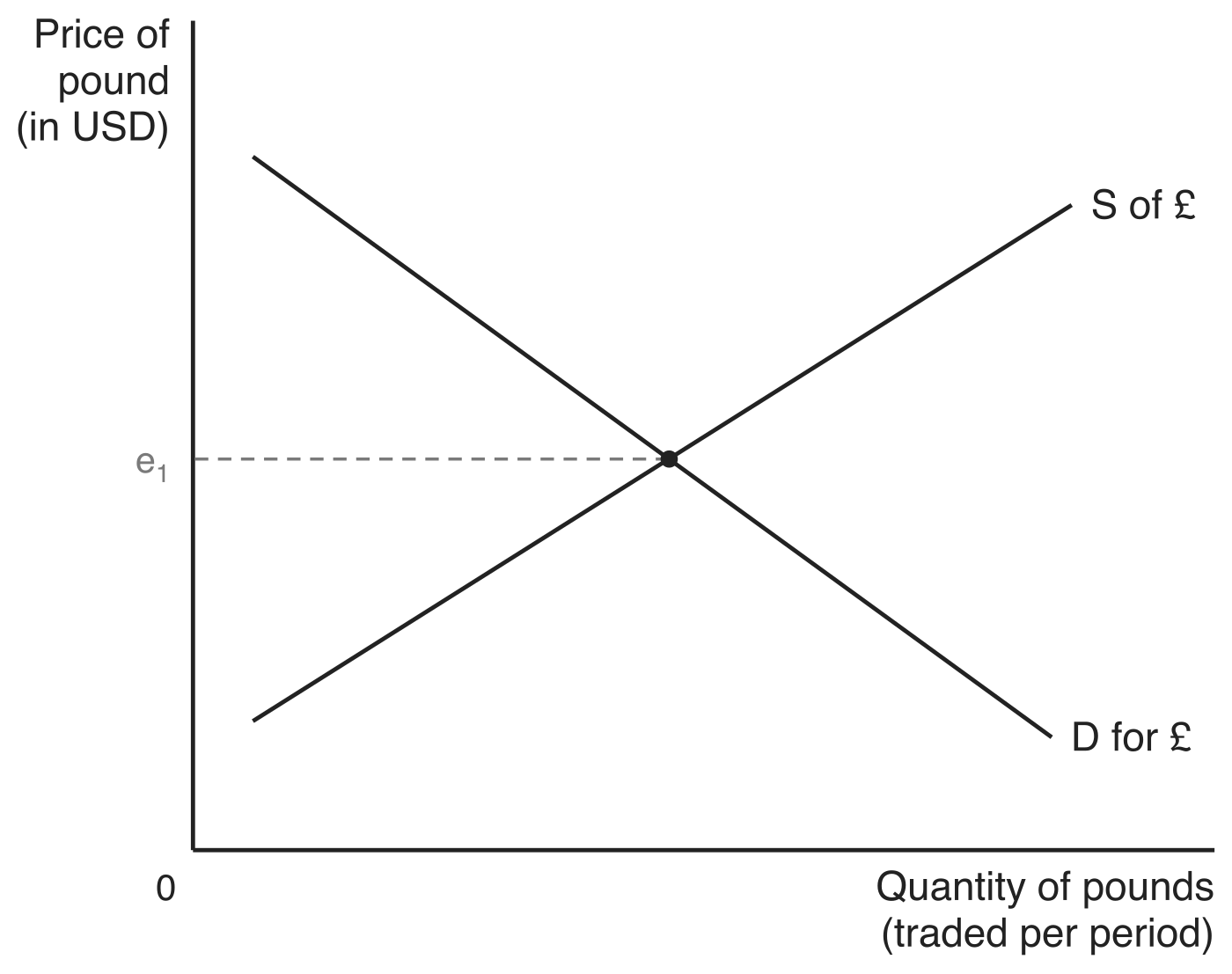
In diagrams showing the market for a currency, the demand curve slopes downwards, while the supply curve slopes upwards, reflecting how changes in the currency's price affect buying and selling behaviour. The diagram below shows the market for pounds, with the price of a pound in US dollars on the vertical axis and the quantity of pounds traded per period on the horizontal axis. D for £ slopes downwards, S of £ slopes upwards, and the two cross at the equilibrium exchange rate e1, say $1.31 per pound. The currency on the horizontal axis is always the one being priced: here the price is dollars per pound, so the quantity axis measures pounds.
Reasons for the downward-sloping demand curve
When a currency becomes cheaper (its exchange rate falls):
- Fewer units of foreign currency are required to purchase it.
- The country's exports become more affordable and competitive internationally.
- It becomes less expensive for foreigners to invest in the country.
These factors increase the quantity demanded of the currency as its price falls, which is why D for £ is negatively sloped.
Reasons for the upward-sloping supply curve
When a currency becomes cheaper (its exchange rate falls):
- More units of the domestic currency are needed to buy foreign currency.
- Imports become more expensive for domestic residents.
- Investing abroad becomes more expensive for domestic residents.
These effects reduce the quantity supplied of the currency at a lower exchange rate, and the same reasoning read the other way means a higher exchange rate brings a larger quantity supplied. That is why S of £ slopes upwards.