3.7 - Increasing Food Production
Fertilisers
- Plants need mineral ions from the soil to grow properly:
- Nitrogen - For making proteins
- Phosphorus
- Potassium
- When a crop grows, it takes these mineral ions out of the soil, leaving the soil short of them for the next crop.
- Farmers add fertiliser to replace the missing mineral ions, or to provide extra - this boosts plant growth and so raises the crop yield.
Natural and artificial fertilisers
- Natural - Such as farmyard manure, slurry or compost. They release nutrients slowly and improve the soil.
- Artificial - Made industrially and usually rich in nitrogen, phosphorus and potassium (NPK). They're easy to apply and their mineral content is easy to measure accurately.
Problems caused by fertilisers
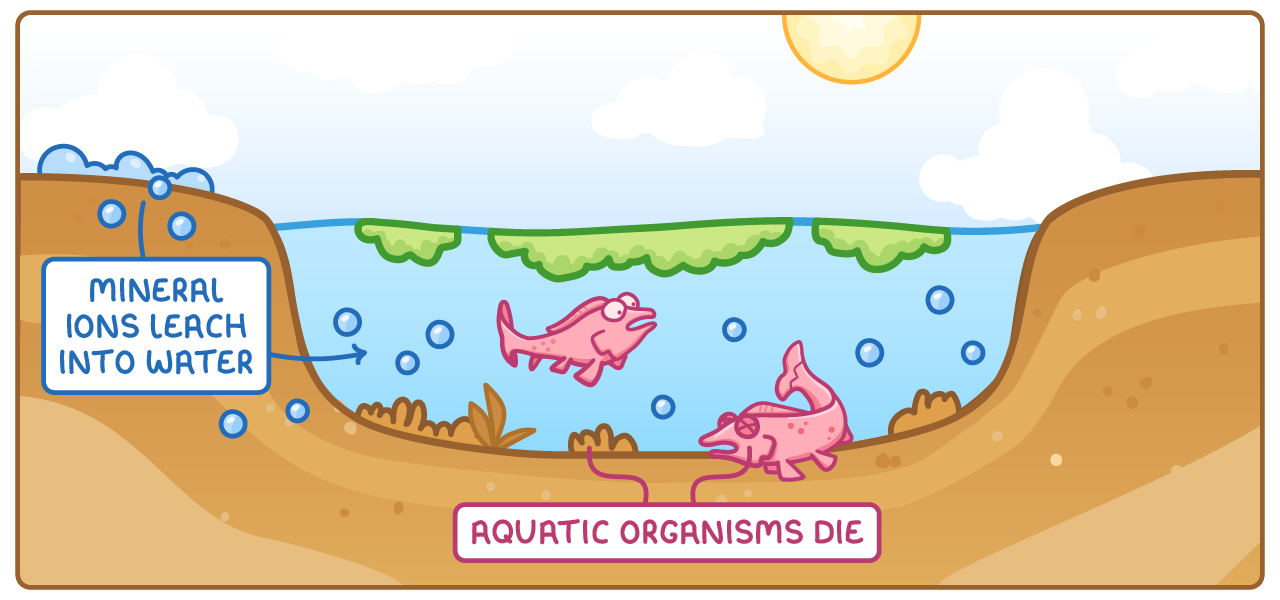
- If too much fertiliser is applied and it rains, the soluble mineral ions are easily washed off the fields.
- They leach into rivers and lakes, where the excess nutrients can lead to the death of aquatic organisms.
Pesticides and bioaccumulation
- Pesticides are a form of chemical pest control - sprayed onto crops to kill the pests that damage them.
- Fewer plants are lost, so the yield rises.
Types of pesticide
- Insecticides - Kill insects
- Herbicides - Kill weeds
- Fungicides - Kill fungi
Drawbacks of pesticides
- Often poisonous to humans, so they must be used carefully to keep the amount left in food below a safe level.
- Many harm wildlife that aren't pests, such as bees and ladybirds. This can leave less food for animals higher up the food chain.
Bioaccumulation
- Some pesticides are not broken down and persist in the bodies of organisms that take them in.
- When a sprayed plant is eaten, the pesticide passes into the animal, then into whatever eats that animal.
- At each stage up the food chain, the concentration of pesticide in the organisms increases.
- Eventually organisms at the top can receive a lethal dose.
- This build-up of a toxic substance in living organisms along a food chain is called bioaccumulation.
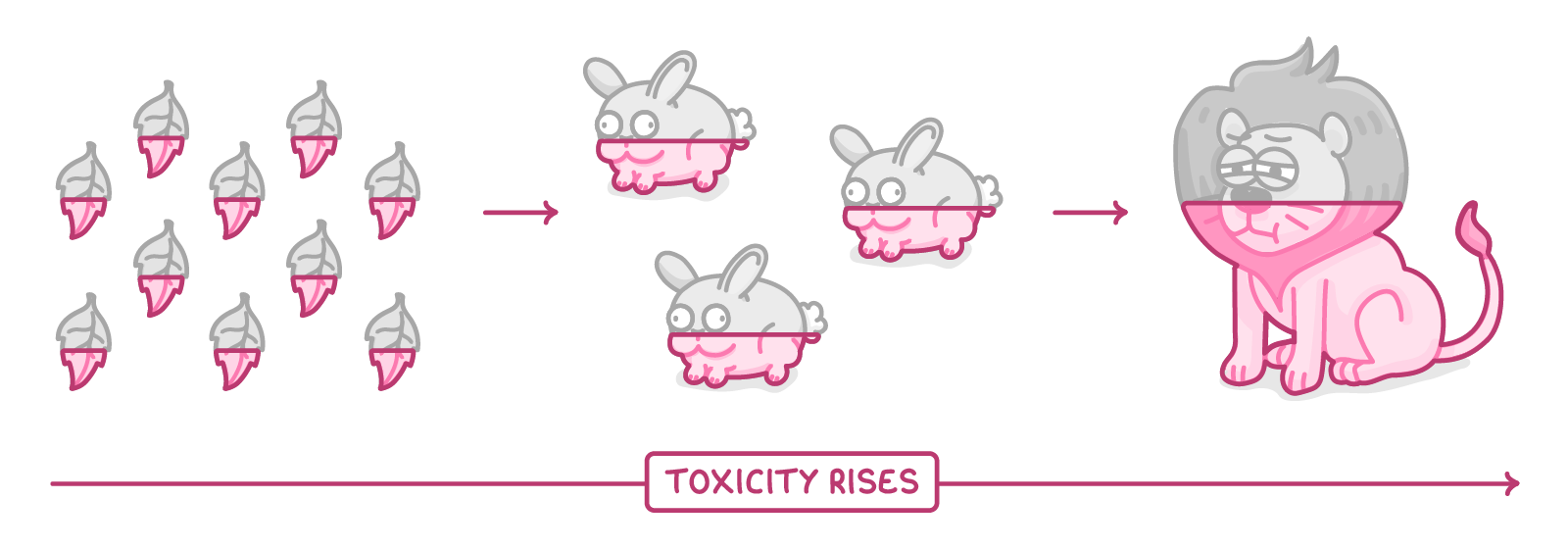
Pink shows the pesticide, more concentrated at each step up the food chain.
Biological control
- Biological control is an alternative to chemical pesticides: instead of spraying poison, farmers use other living organisms to reduce the numbers of a pest.
- This is done either by encouraging organisms already in the area or by adding new ones.
Types of helpful organism
- Predators - Such as ladybirds that eat aphids
- Parasites - Such as flies whose larvae develop on or in a host insect and eventually kill it
- Disease-causing organisms - These infect the pest
Advantages over pesticides
- No chemicals used - Means less pollution and less risk to people eating the food
- No toxic chemicals passing along food chains
- Longer-lasting effect - Spraying often has to be repeated, but biological control can last longer
The risk of introducing new organisms
Biological control does carry a risk: introducing a new organism into an ecosystem can cause problems of its own.
Example: cane toads were brought into Australia to eat the beetles damaging crops, but the toads became a major pest themselves - they poison the native animals that try to eat them.
Intensive animal farming
- Intensive (or efficient) animal farming aims to produce as much meat, milk or eggs as possible from a given input of resources.
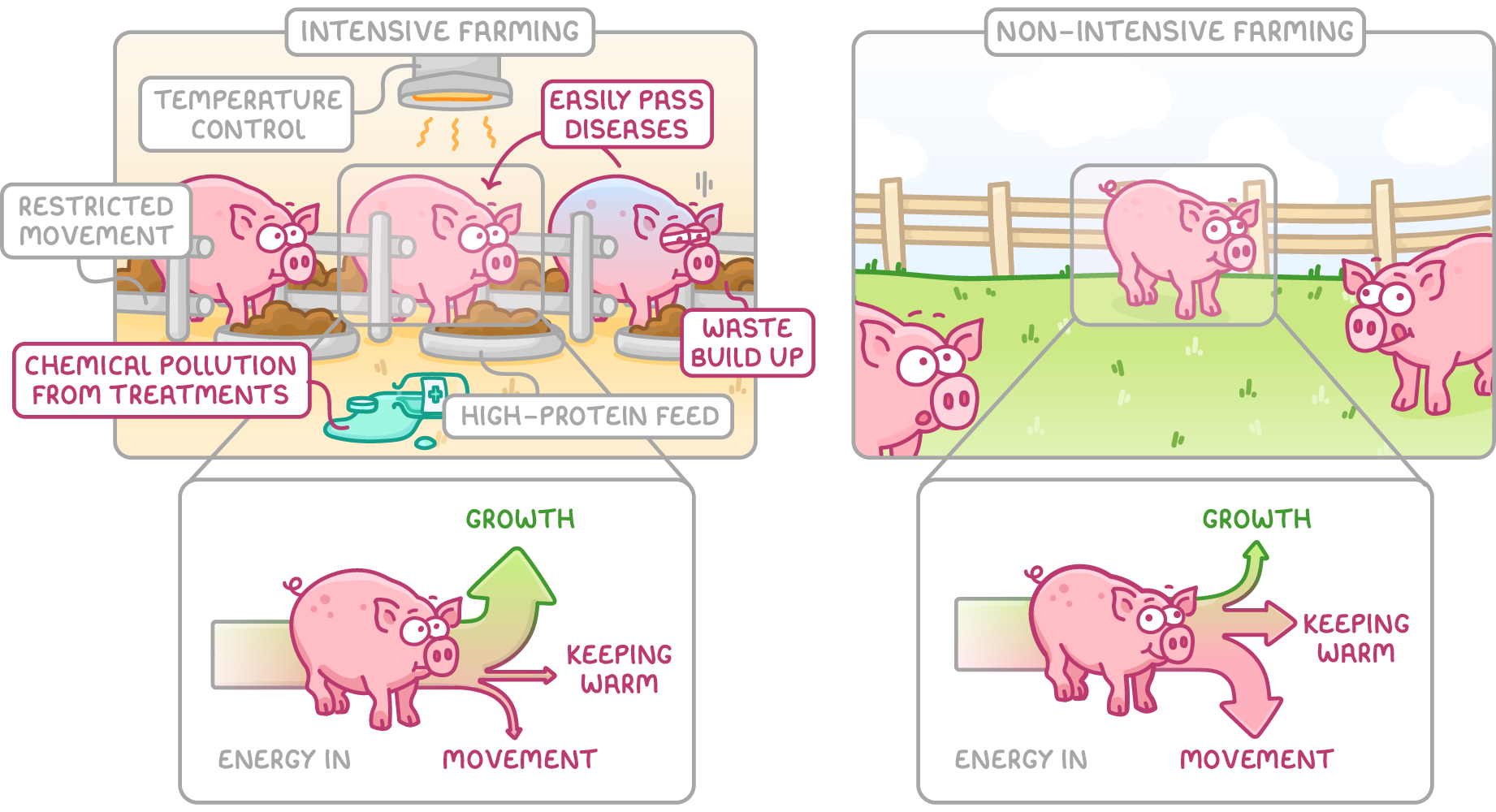
- The central idea is to reduce the energy that farm animals transfer to their surroundings, so more of the energy in their food is left for growth.
How energy is channelled into growth
- Animals' movement is limited, often by keeping them in small pens or cages.
- They're kept in a temperature-controlled environment.
- An animal that moves little and doesn't have to keep itself warm uses less energy on those things, so more energy goes into building body mass - more food is produced from the same amount of feed.
- Animals are sometimes given high-protein feed to increase growth further.
Advantages
- More food is produced from the same amount of feed.
- Confining animals makes it easier for the farmer to monitor them and protect them from predators.
- It lowers the cost of the food for the consumer.
Disadvantages
- Animals kept close together can pass diseases between them easily.
- Their waste can build up and pollute nearby water.
- The chemicals used to treat them can pollute too.
- Many people have ethical objections, arguing that keeping animals in such cramped, unnatural conditions is cruel.
TermDefinition
BioaccumulationThe build-up of a toxic substance in living organisms along a food chain, because it is not broken down or excreted.
Biological controlUsing a living organism, such as a predator or parasite, to reduce the numbers of a pest or pathogen.