10.13 - Carboxylic Acids
The carboxylic acids
- Carboxylic acids are a homologous series - a family built on the same pattern: they share a general formula, each member differs from the next by a CH2 unit, and they all have similar chemical properties.
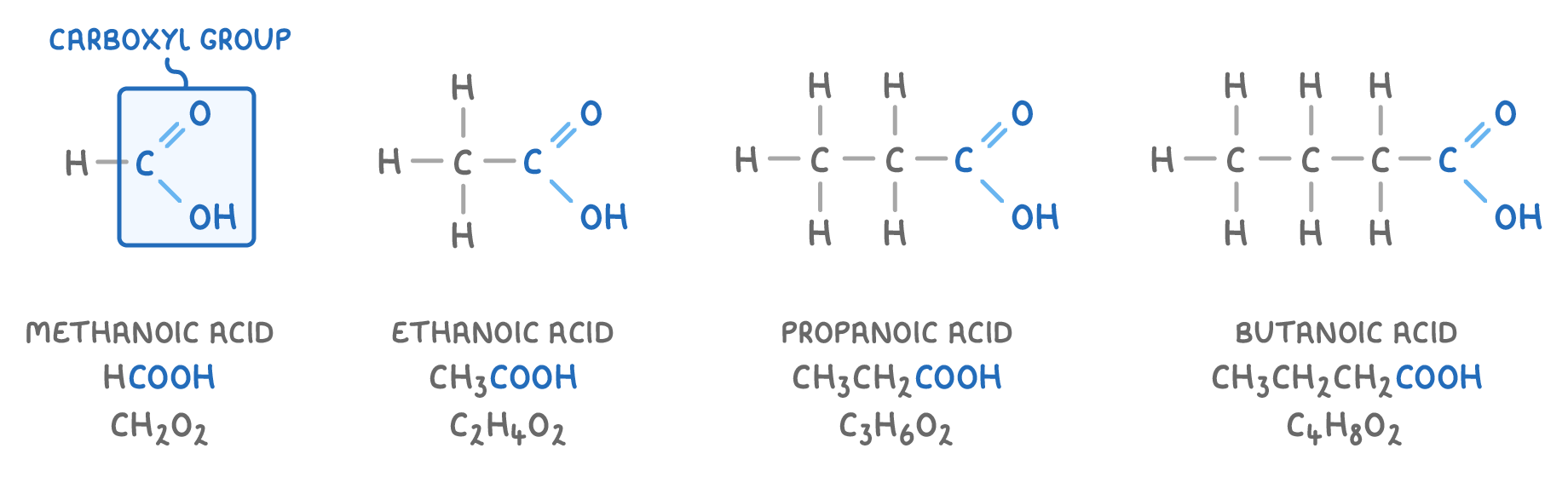
- They all share the functional group -COOH, the carboxyl group:
- A carbon atom joined to two oxygen atoms - one by a double bond, the other by a single bond.
- That second oxygen carries a hydrogen atom on a single bond.
- The carbon uses its fourth bond to join to the rest of the chain.
- It's the hydrogen atom on that oxygen that makes the compound an acid.
Naming carboxylic acids
- All names end in -oic acid, and the prefix says how many carbon atoms the molecule has: meth- (1), eth- (2), prop- (3), but- (4).
- The carbon atom in the carboxyl group is counted in - Ethanoic acid has two carbon atoms in all, one of them the carbon of the COOH.
The first four members
- Written on one line, the four atoms of the group are kept together at the end as COOH, so the group can be seen at a glance.
- The molecular formula gives the totals and hides the group. For example, C2H5COOH and C3H6O2 are the same molecule written two different ways.
- All four acids are liquids at room temperature and pressure.
Where they turn up
- Vinegar is a dilute solution of ethanoic acid in water, which gives it its sharp taste and smell.
- Carboxylic acids are used in foods (as flavours and preservatives) and in personal care products such as soaps.
What carboxylic acids do
- Carboxylic acids are a family of organic acids. A solution of one behaves the way any other acid solution behaves.
- When dissolved in water, a carboxylic acid forms an acidic solution.
- It's acidic because the acid releases hydrogen ions, H+, into the water.
- Because it contains hydrogen ions, the solution has a pH below 7 and turns universal indicator red, orange or yellow.
Reaction with a carbonate
Adding a carboxylic acid to a carbonate causes fizzing: the solid disappears, leaving a colourless solution as a gas bubbles off.
carboxylic acid + carbonate → a salt + water + carbon dioxide
- The gas is carbon dioxide, which turns limewater milky.
- The salt is named from the acid, with the -oic acid ending replaced by -oate (e.g. ethanoic acid makes ethanoates). The metal comes first:
ethanoic acid + sodium carbonate → sodium ethanoate + water + carbon dioxide
Reaction with an alcohol
A carboxylic acid reacts with an alcohol in the presence of an acid catalyst to produce an ester:
carboxylic acid + alcohol → an ester + water
Carboxylic acids are weak acids
An acid releases hydrogen ions, H+, when dissolved in water by ionising.
Strong versus weak
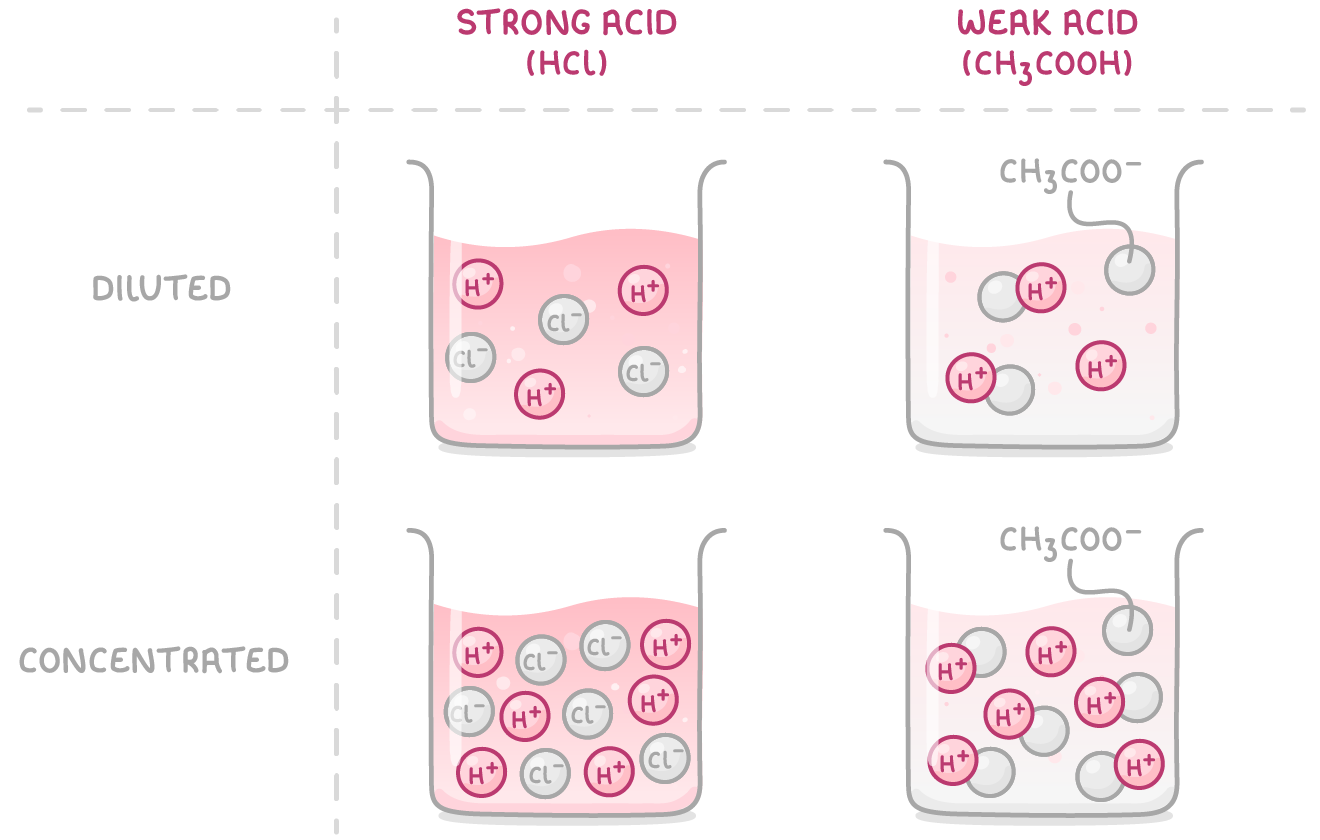
- Strong acid - Ionises completely in water. Every molecule splits up to release its H+ ion.
- Weak acid - Ionises only partially in water. Only a small fraction of the molecules release their H+ ions, forming an equilibrium mixture of ions and un-ionised molecules.
Carboxylic acids are weak acids because they only partially ionise in aqueous solution.
Why this changes the pH
- pH depends on the concentration of hydrogen ions: the higher the concentration of H+, the lower the pH.
- At the same concentration, a weak acid has fewer free H+ ions in solution than a strong acid.
- Therefore, a weak acid has a higher pH and reacts more slowly than a strong acid of the same concentration.
Strength and concentration are different things
- Concentration is the amount of acid dissolved per unit volume.
- Strength is the fraction of acid molecules that ionise in water.
Writing an equation and naming the salt
A reaction of a carboxylic acid can be written as a balanced symbol equation using six steps, shown here for ethanoic acid with sodium carbonate.
Step 1 - Write down what is reacting
Ethanoic acid and sodium carbonate.
Step 2 - Decide the products
- Reaction with a metal → salt + hydrogen
- Reaction with a metal oxide (or hydroxide) → salt + water
- Reaction with a carbonate → salt + water + carbon dioxide
For ethanoic acid and sodium carbonate, the products are a salt, water and carbon dioxide.
Step 3 - Name the salt
- The metal gives the first part of the name (sodium), and the acid provides the second part ending in -oate (ethanoate).
- Salt = sodium ethanoate.
Step 4 - Write the word equation
ethanoic acid + sodium carbonate → sodium ethanoate + water + carbon dioxide
Step 5 - Replace every name with its formula
- The carboxylate ion has a 1- charge: methanoate (HCOO-), ethanoate (CH3COO-), propanoate (C2H5COO-), butanoate (C3H7COO-).
- Sodium forms Na+, so the formula is CH3COONa:
- CH3COOH + Na2CO3 → CH3COONa + H2O + CO2
Step 6 - Balance it
Balance the atoms by adding coefficients:
2CH3COOH + Na2CO3 → 2CH3COONa + H2O + CO2
Worked example - Acid with a metal
Write the balanced symbol equation for the reaction of ethanoic acid with magnesium.
Step 1 - Write down what is reacting
Ethanoic acid and magnesium.
Step 2 - Decide the products
An acid reacting with a metal produces a salt and hydrogen.
Step 3 - Name the salt
Metal = magnesium, acid = ethanoic acid, so the salt is magnesium ethanoate.
Step 4 - Write the word equation
ethanoic acid + magnesium → magnesium ethanoate + hydrogen
Step 5 - Replace every name with its formula
Magnesium forms Mg2+ and ethanoate is CH3COO-, so two ethanoate ions balance one magnesium ion: (CH3COO)2Mg.
CH3COOH + Mg → (CH3COO)2Mg + H2
Step 6 - Balance it
Two ethanoate groups are needed on the left:
2CH3COOH + Mg → (CH3COO)2Mg + H2