10.9 - Thermal Stability of Metal Carbonates
The experiment
Aim
To compare how readily calcium carbonate, copper(II) carbonate, and sodium carbonate decompose on heating, and use the results to rank the three carbonates in order of thermal stability.
Background
- Many metal carbonates break down when heated, forming a metal oxide and carbon dioxide. This is thermal decomposition.
- Some carbonates decompose much more easily than others. A carbonate that needs a higher temperature to decompose has a higher thermal stability.
- You can't see the carbon dioxide escaping, but you can weigh the tube before and after heating, because the mass of the carbon dioxide is lost.
- So in this practical you heat each carbonate in the same way, and use how much mass it loses to rank the carbonates by thermal stability.
Variables
- Independent variable - Which carbonate is heated.
- Dependent variable - The loss in mass of the tube and its contents, once the tube has cooled.
- Control variables - The mass of carbonate, the size of the flame, the heating time, and the distance from the flame to the tube.
Method
- Weigh an empty boiling tube - And record its mass.
- Add the carbonate - Add about 2 g of calcium carbonate, and weigh the tube and its contents.
- Heat strongly - Heat the tube in a roaring Bunsen flame for about five minutes, holding it at the same distance from the flame throughout.
- Cool and weigh again - Let the tube cool completely, then record the mass of the tube and its contents.
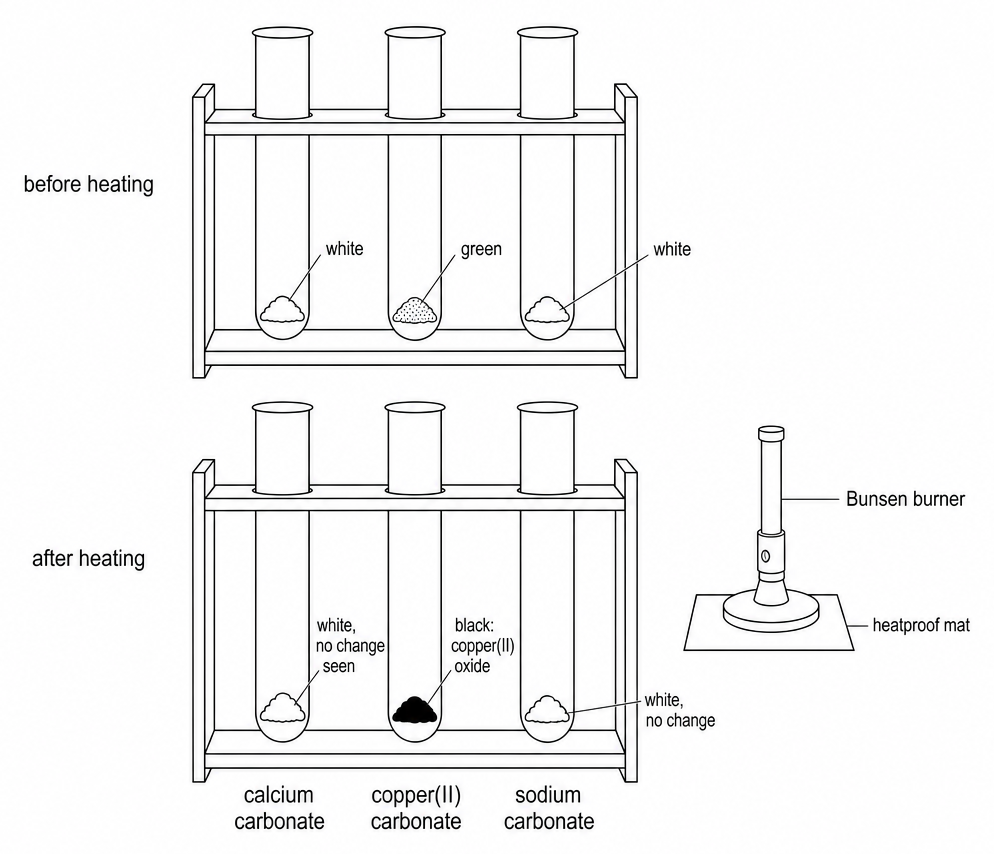
- Repeat with the other carbonates - Use the same mass of copper(II) carbonate, then sodium carbonate, in a clean tube each time, and note any colour change.
Safety
- Eye protection - Wear it throughout.
- Point the tube away from people - copper(II) carbonate is harmful and sodium carbonate is an irritant, and either can spit out of the tube as it's heated.
- Hot tubes - Let each one cool on a heatproof mat before you pick it up.
Worked example - Ranking carbonates by mass loss
A student heated calcium carbonate, copper(II) carbonate, and sodium carbonate in turn, each in its own boiling tube, using the same flame and heating time.
| Calcium carbonate | Copper(II) carbonate | Sodium carbonate | |
|---|---|---|---|
| Mass of empty tube (g) | 19.55 | 19.61 | 19.58 |
| Mass of tube and carbonate before heating (g) | 21.67 | 21.66 | 21.66 |
| Mass of tube and contents after heating (g) | 21.31 | 20.97 | 21.66 |
Calculate the loss in mass for each carbonate, express it as a percentage of the starting mass, and rank the three by thermal stability.
Step 1 - Find the mass of each carbonate used
Subtract the mass of the empty tube from the mass before heating.
- For calcium carbonate, the mass is 21.67 − 19.55 = 2.12 g.
- For copper(II) carbonate, the mass is 21.66 − 19.61 = 2.05 g.
- For sodium carbonate, the mass is 21.66 − 19.58 = 2.08 g.
Step 2 - Find the loss in mass
Subtract the mass after heating from the mass before heating.
- For calcium carbonate, the loss is 21.67 − 21.31 = 0.36 g.
- For copper(II) carbonate, the loss is 21.66 − 20.97 = 0.69 g.
- For sodium carbonate, the loss is 21.66 − 21.66 = 0.00 g.
Step 3 - Turn each loss into a percentage
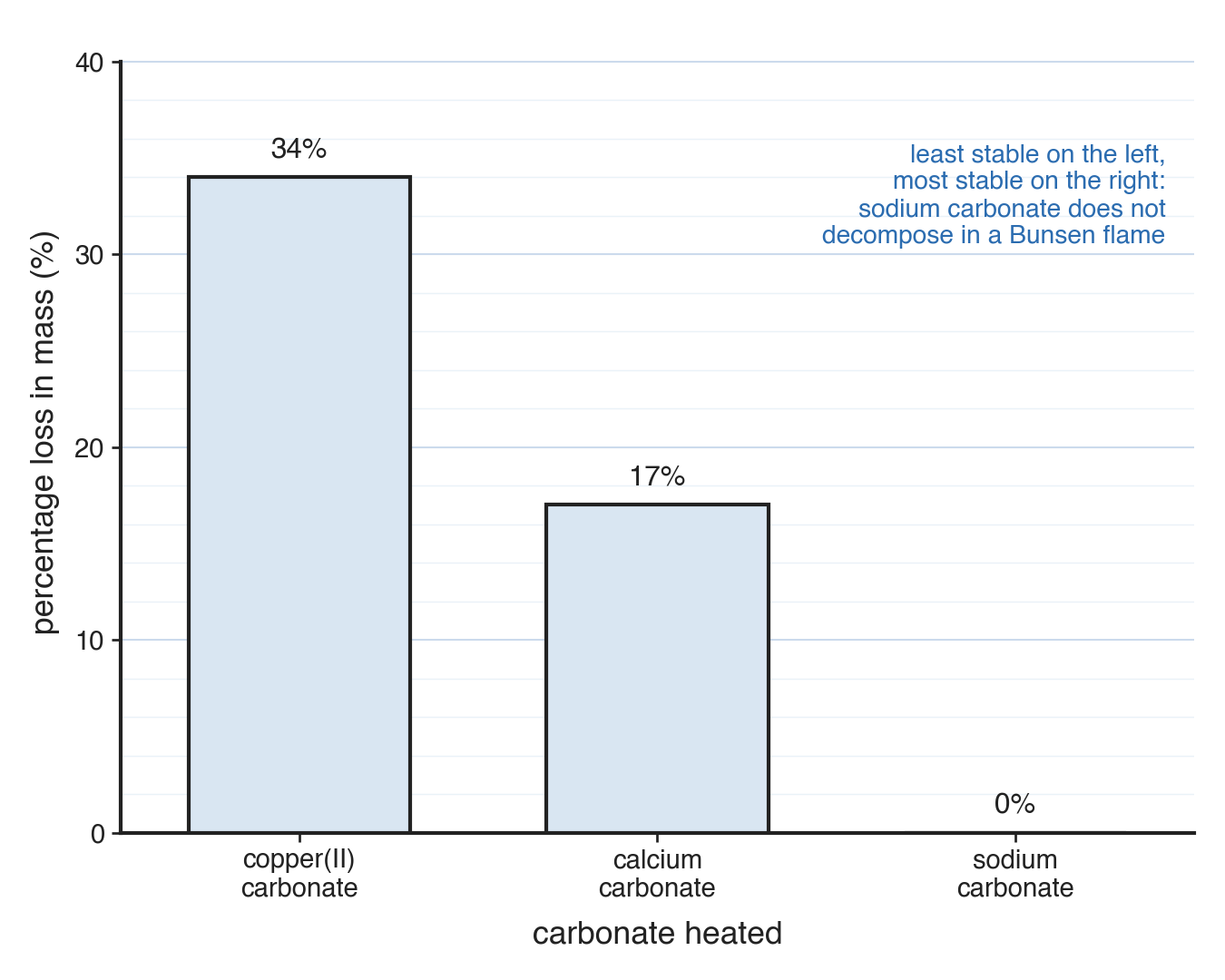
- For calcium carbonate, it's 0.36 ÷ 2.12 × 100 = 17%.
- For copper(II) carbonate, it's 0.69 ÷ 2.05 × 100 = 34%.
- For sodium carbonate, it's 0.00 ÷ 2.08 × 100 = 0%.
Step 4 - Rank the carbonates by thermal stability
The carbonate that loses the greatest percentage has decomposed the most, so it's the least stable. From least to most stable, the order is copper(II) carbonate, calcium carbonate, then sodium carbonate.
Step 5 - Link the ranking to reactivity
Copper is the least reactive of the three metals, and its carbonate is the least stable. Sodium is the most reactive, and its carbonate doesn't decompose at all in a Bunsen flame. So the more reactive the metal, the more stable its carbonate.
Common exam questions
Question 1
What happens to the appearance of copper(II) carbonate when it's heated?
It turns from a green solid to a black solid, as it decomposes to copper(II) oxide.
Question 2
Write the balanced symbol equation for the thermal decomposition of copper(II) carbonate.
CuCO3 → CuO + CO2
Question 3
Why is the same mass of each carbonate used?
So the losses in mass can be compared. If the starting masses were different, a bigger loss in mass might only mean there was more carbonate to begin with.
Question 4
Why must each tube cool before it's weighed?
A hot tube gives an inaccurate reading on the balance, and it could burn whoever picks it up.
Question 5
Why does calcium carbonate look white both before and after heating?
Calcium carbonate and the calcium oxide it forms are both white, so colour alone can't show whether it has decomposed. The loss in mass is the evidence.