8.2 - Terminal Speed of a Falling Object
The experiment
Aim
To measure the terminal speed of falling paper cupcake cases, and to find out how that terminal speed depends on the mass of the object falling.
Background
- A falling object has two forces on it, its weight downwards and drag from the air upwards.
- As it speeds up, the drag grows, so the resultant force and the acceleration get smaller.
- When the drag equals the weight, the resultant force is zero, and the object falls at a steady terminal speed.
- A heavier object of the same shape has to fall faster before the drag balances its weight.
- You can't measure terminal speed directly, but you can time how long the object takes to fall a measured distance once it's reached it.
- So in this practical you time stacks of cupcake cases falling from a pointer to the floor, and work out each terminal speed.
Variables
- Independent variable - The mass, set by the number of cupcake cases stacked together.
- Dependent variable - The time to fall from the pointer to the floor, which gives the terminal speed.
- Control variables - The release height, the distance from the pointer to the floor, the shape of the cases, and still air.
Method
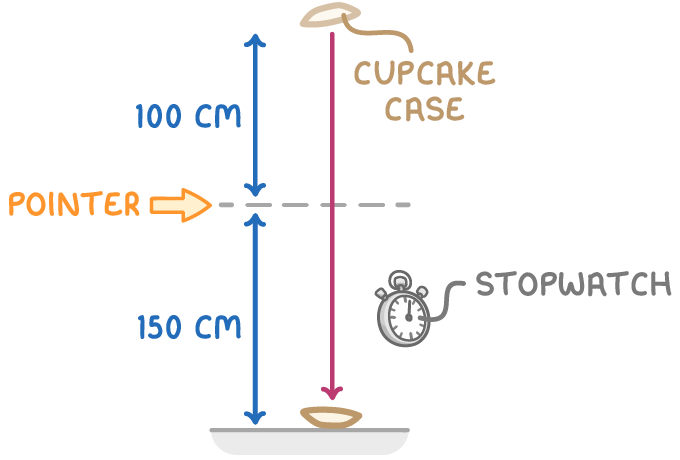
- Set up a pointer - Clamp a pencil in a clamp stand at the edge of a desk, and measure the distance from the pointer to the floor. Make it at least 150 cm.
- Find the mass - Weigh one cupcake case, or weigh ten and divide by ten if one is too light for the balance.
- Drop the case - Hold it about 1 m above the pointer, and let go without pushing it.
- Time the fall - With your eye level with the pointer, start the stopwatch as the case passes it, and stop it when the case hits the floor.
- Repeat - Drop the case at least three times and find the mean time.
- Add more cases - Stack two cases inside one another, find the mass, and repeat, up to at least six different masses.
- Plot the graph - Work out each terminal speed from speed = distance ÷ time, and plot terminal speed against mass.
Safety
- Keep the stand steady - Keep it back from the edge of the desk, and don't reach across it.
- No stools - Don't stand on a stool to get extra height.
Worked example - Terminal speed of four cases
A student measured the terminal speed of a stack of four cupcake cases. The pointer was 1.50 m above the floor, and each time the stack was released 1.0 m above the pointer. These are the times it took to fall from the pointer to the floor.
| Drop | 1 | 2 | 3 | 4 | 5 |
|---|---|---|---|---|---|
| Time (s) | 1.51 | 1.48 | 1.98 | 1.52 | 1.49 |
The student also filmed a drop against a metre rule and plotted a distance-time graph. Two points on its straight section are (0.40 s, 0.20 m) and (1.40 s, 1.20 m).
Find the terminal speed, explain how the student can be sure it's a terminal speed and not just an average speed, and check it with the graph.
Step 1 - Leave out the anomalous result
Drop 3 took 1.98 s, nearly half a second longer than the others. It's an anomalous result, probably from the stack tipping or catching a draught, so it's left out of the mean. Including it would make the speed too low.
Step 2 - Find the mean time
Step 3 - Calculate the terminal speed
The distance is the 1.50 m from the pointer to the floor, not the whole fall.
Step 4 - Explain why this is the terminal speed
The timing started only after the stack had fallen 1.0 m, while the drag built up and the stack sped up. By the time it reached the pointer, the drag equalled the weight, so the stack fell at a steady speed for the whole timed section. Timing from release would give a mean speed for the whole drop, which is lower because it includes the slow start.
Step 5 - Check the speed with the distance-time graph
The graph curves upwards as the stack speeds up, then becomes straight once it stops accelerating. The gradient of the straight section is the terminal speed.
This agrees with the stopwatch answer. The curved start is left out, because it includes the accelerating stage and would give too low a value.
Common exam questions
Question 1
Why are paper cupcake cases used rather than a small stone?
A cupcake case is light and not streamlined, so it reaches a terminal speed after a short fall, slow enough to time with a stopwatch. A stone would have to fall a very long way first.
Question 2
Why should the doors and windows of the room be shut?
A draught pushes the falling case sideways or holds it up, which changes the time it takes to fall. Still air means only the mass affects the result.
Question 3
Why is the mass increased by stacking cases inside one another, rather than by taping a coin to a single case?
Stacking adds mass without changing the shape or the area facing the air. A taped coin changes the shape and how the case falls, so two things would change at once.
Question 4
Why is the distance from the pointer to the floor made at least 150 cm?
A longer distance gives a longer time, so the reaction-time error in starting and stopping the stopwatch is a smaller fraction of the reading. That reduces the percentage uncertainty in the speed.
Question 5
A skydiver opens their parachute. Describe what happens to their speed and explain why.
The parachute's large area makes the drag much bigger than their weight, so they slow down. As they slow, the drag falls until it equals their weight again, at a new, lower terminal speed.