17.8 - Potential Dividers
A potential divider shares a voltage between two resistors
- A potential divider is a circuit that splits a supply voltage between two resistors in series.
- It allows a circuit to take a smaller voltage from a larger supply.
- The supply's potential difference is shared between the two resistors in the ratio of their resistances: the larger a resistor's share of the total resistance, the larger its share of the voltage.
Because the same current passes through both resistors in series, a larger resistance has a larger potential difference across it.
Worked through with numbers
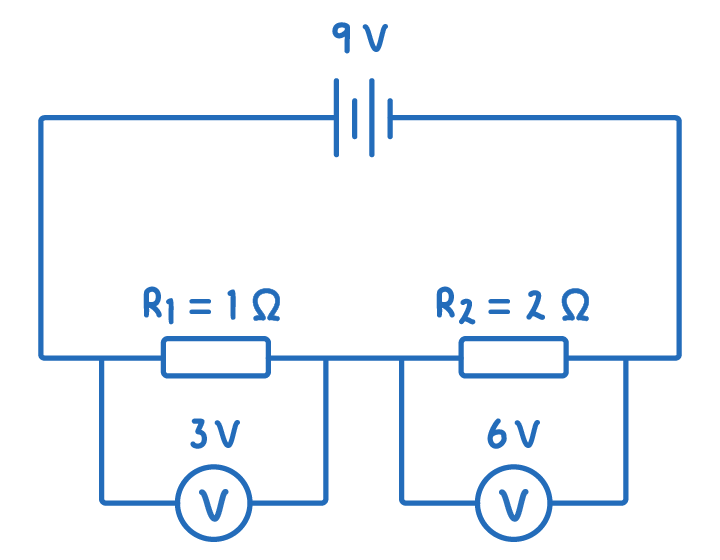
A 9 V supply is connected across a 2 Ω resistor and a 1 Ω resistor in series, as shown in the circuit below.
- Total resistance = 2 + 1 = 3 Ω.
- The 2 Ω resistor takes 2/3 of the supply: 2/3 of 9 V = 6 V.
- The 1 Ω resistor takes 1/3 of the supply: 1/3 of 9 V = 3 V.
- The two shares add up to the 9 V supply.
TermDefinition
Potential dividerA circuit that splits a supply voltage between two resistors in series.